


A Note from James:
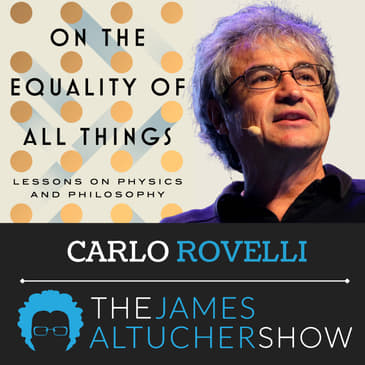
Carlo Rovelli is one of the smartest people I know. He is a theoretical physicist and the author of a lot of great books, including Seven Brief Lessons on Physics, The Order of Time, Helgoland, White Holes, and now On the Equality of All Things: Lessons on Physics and Philosophy.
He has been on the show before, and at the end of this conversation I told him I felt like he was just tolerating my questions. He was nice about it.
But the first question I asked was: Do I actually exist?
Because in Carlo’s new book, nothing really exists on its own. Not a person, not a particle, not you, not me. Everything exists in relation to something else.
So I spent an hour trying to understand what that means.
Does absolute truth exist? Is free will fake? Are we just machines? Is consciousness quantum? Is everything doomed to decay? Is time real? Was there a before the Big Bang? And what does any of this actually do for us in ordinary life?
Carlo’s answer, again and again, is not that nothing is real. It is that we make a mistake when we try to imagine the world from the outside, as if we were standing somewhere beyond the universe looking in. We are not outside the universe. We are inside it. We are part of it. We know the world through relationships, perspectives, interactions, and limits.
And oddly, that is calming.
Because Carlo says the thing that brought him serenity was not finally knowing everything. It was giving up the need to know everything with absolute certainty.
That is where this conversation goes: physics, quantum mechanics, philosophy, Buddhism, Taoism, Wittgenstein, consciousness, black holes, time, the Big Bang, free will, and the strange comfort of not needing the final answer.
Episode Description:
Carlo Rovelli returns to the show for a conversation about reality, uncertainty, quantum mechanics, time, consciousness, free will, and his new book On the Equality of All Things: Lessons on Physics and Philosophy.
James begins with the central idea of the book: everything in the universe can only be understood in relation to something else. Carlo agrees that this is a good short version of the argument, but immediately pushes back against the need for “absolute” truth. Of course James exists. Of course Carlo exists. The question is why we need to add something heavier and more final than that.
From there, the conversation becomes an exploration of relational reality. Carlo explains that motion is not an illusion just because it depends on perspective. When James says he is sitting still, that is true with respect to Earth. When someone says Earth is moving, that is true with respect to the sun or the galaxy. The mistake is asking which motion is the “real” one outside all relations.
The same frame applies to quantum mechanics. Carlo argues that particles are not little objects with fixed properties sitting there independently of the rest of the world. A particle is what it manifests in interaction. It is a set of relations. This is why quantum mechanics has forced such a profound change in the way physicists think about reality.
James keeps pressing the practical question: What do we gain from knowing this?
Carlo’s answer is partly scientific and partly philosophical. We gain better questions. We stop asking impossible questions like “Who is really not moving?” or “What is the final foundation of everything?” We become more aware of our own perspective. And we may become more capable of understanding people whose moral, political, or philosophical perspectives differ from ours.
The conversation moves through the Big Bang and the possibility of a Big Bounce, with Carlo stressing that science is powerful precisely because it knows its own ignorance. Science is not the final story. It is an ongoing process of learning, correcting, testing, and replacing older models with better ones.
James and Carlo then talk about time. Carlo explains that Earth is so small, compared with the universe, that we experience conversation as almost instantaneous. That gives us the illusion that time is the same for everyone. But physics has shown that time is not universal. Every star and galaxy has its own time, and the idea of “now” across the whole universe does not really work.
The second half of the conversation turns toward philosophy and human life. Carlo connects his thinking to Eastern philosophy, Zhuangzi, Buddhism, Taoism, and Wittgenstein. For him, accepting the partial, perspectival, incomplete nature of knowledge is not depressing. It is serene.
James also asks about consciousness, free will, and whether quantum mechanics can explain the mind. Carlo respects Roger Penrose but says he does not think consciousness is specifically quantum. The brain is physical. Choices are physical. But that does not make choice unreal. The mistake, Carlo says, is imagining a separate ghost or soul outside the physical brain that is supposed to make the decision.
The episode closes with James trying to find one absolute: everything decays. Carlo says no. The universe also creates order. Galaxies form. Stars light up. Life emerges. Water and oil separate into structure. Civilization produces books. Nature is not simple decay. It is more complicated, more beautiful, and still not fully understood.
What You’ll Learn:
- Why Carlo Rovelli thinks there is no useful “view from outside” the universe.
- Why existence does not need to be “absolute” to be real.
- How motion only makes sense relative to something else.
- Why relative does not mean arbitrary.
- How quantum mechanics challenges the idea that the world is made of independent objects.
- Why Carlo sees particles as manifestations of interactions.
- Why science is powerful partly because it knows what it does not know.
- What the Big Bounce idea suggests about the Big Bang.
- Why time is not the same everywhere in the universe.
- Why there may be no single universal “now.”
- Why physics does not explain everything, even if nothing escapes physics.
- How Eastern philosophy, Taoism, Buddhism, and Wittgenstein shaped Carlo’s thinking.
- Why giving up certainty can create serenity.
- Why Carlo does not think consciousness is specifically quantum.
- How Carlo thinks about free will without invoking a separate soul or ghost.
- Why quantum mechanics should not be turned into vague New Age thinking.
- Why nature is not only decay, but also structure, order, evolution, and growth.
Timestamped Chapters:
[05:04] Does Anything Exist Absolutely?
James asks whether he, Carlo, or the chair exists, and Carlo explains why ordinary existence is enough without adding the word “absolute.”
[06:47] We Exist Through Relations
Carlo explains that identity, friendship, love, social position, and knowledge all happen through relationships.
[08:41] Motion Is Relative, Not Fake
James uses the example of sitting still while Earth moves, and Carlo explains why “really moving” is the wrong question.
[09:31] Morality Without Absolutes
Carlo argues that morality can be meaningful and powerful without being independent of human beings.
[10:44] Relative Does Not Mean Arbitrary
Carlo clarifies that relational truth is not the same as saying anything goes.
[12:05] Quantum Mechanics and the Relational World
Carlo explains how quantum mechanics led him toward the idea that things do not have fixed properties independent of interaction.
[14:35] What Happens When We Are Not Looking?
James asks why quantum mechanics feels strange, and Carlo explains that the confusion begins when we try to describe what happens without interaction.
[16:29] Everything Is a Process
Carlo connects quantum reality to everyday reality: apples rot, stones become sand, and nothing is perfectly fixed forever.
[17:21] Before the Big Bang?
James asks what the first particle could have interacted with, and Carlo explains why the Big Bang may not have been an absolute beginning.
[20:22] The Big Bounce
Carlo discusses the possibility that the universe went through a phase of maximum compression before expanding.
[21:40] Science Knows Its Ignorance
Carlo explains why science is not about having final answers, but about knowing what we know and what we still do not know.
[22:58] Science Is Not the Final Story
James asks about string theory and scientific certainty, and Carlo says science is an ongoing process of learning more.
[24:29] Physics Does Not Explain Everything
Carlo explains why fundamental physics underlies everything but does not replace chemistry, biology, mechanics, or other forms of knowledge.
[25:13] Time Is Not the Same for Everyone
James asks about time, distance, and the Big Bang, and Carlo explains why the idea of one universal “now” is an illusion.
[27:44] How Do We Know Anything?
Carlo defends the power of science, pointing to Maxwell, Einstein, black holes, gravitational waves, and GPS.
[30:11] Will Science Ever Be Complete?
James asks whether even an advanced alien civilization would still face unknowns, and Carlo says he doubts science will ever reach a final story.
[31:20] Gödel, Ignorance, and No Theory of Everything
Carlo treats Gödel’s theorem as an analogy for the impossibility of closing knowledge, while stressing how far we still are from complete understanding.
[32:49] Zhuangzi, Taoism, and Serenity
James connects Carlo’s thinking to Eastern philosophy, and Carlo explains why giving up the need for certainty made his life more serene.
[37:00] Consciousness and Quantum Mechanics
James asks about Roger Penrose and consciousness; Carlo says he does not think the brain is specifically quantum in the relevant sense.
[38:08] Consciousness as Perspective
Carlo explains consciousness as part of a relational world: a piece of nature with information about the rest of nature.
[41:06] Avoiding New Age Quantum Thinking
James asks about law-of-attraction-style interpretations, and Carlo distinguishes serious quantum theory from vague extrapolation.
[42:53] Objects Are Not as Solid as They Seem
Carlo says quantum mechanics challenges the idea that the world is made of fixed, independent objects with properties of their own.
[44:22] Arguing With the Metaphysicians
Carlo describes the Princeton philosophy conversations that helped become the basis of the book.
[46:29] Copernicus, Darwin, and Quantum Reality
Carlo compares quantum mechanics to earlier scientific revolutions that forced humans to rethink their place in the world.
[48:18] What Will Future Science Change?
James asks what discoveries might blow our minds 100 or 200 years from now, and Carlo points to quantum gravity, black holes, and the mind.
[51:10] Free Will Without the Ghost
James asks about determinism and choice; Carlo says freedom is not an illusion, but the idea of a separate nonphysical chooser is.
[54:11] Does Everything Decay?
James tries to find one absolute truth, and Carlo says nature also produces structure, complexity, life, and order.
Additional Resources:
- On the Equality of All Things — Simon & Schuster
- Carlo Rovelli — Simon & Schuster Author Page
- Carlo Rovelli — Penguin Random House Author Page
- Science Friday: “Why physics and philosophy need each other”
- Helgoland — Penguin Random House
- White Holes — Penguin Random House
- Seven Brief Lessons on Physics — Penguin Random House
- The Order of Time — Penguin Random House
- Reality Is Not What It Seems — Penguin Random House
- Anaximander — Penguin Random House
See Privacy Policy at https://art19.com/privacy and California Privacy Notice at https://art19.com/privacy#do-not-sell-my-info.
[00:00:29] Rovelli, James Altucher Show.
[00:01:03] Carlo Rovelli is one of the smartest people I know. And he's a theoretical physicist. He's written a ton of great books. His new book is On the Equality of All Things, Lessons on Physics and Philosophy. He's been on the show before. And look, at the end of this one, I told him I felt like he was just tolerating my questions. And he was nice about that. But the very first question I asked was, do I in fact exist?
[00:01:30] because in his new book, On the Equality of All Things, I'll try to summarize it a little bit. Nothing actually exists on its own. Not a person, not a particle, not you. Everything only exists in relation to other things. And we talk about this on the podcast. And I spent an hour trying to understand this and what are the consequences of this? What does it mean? You know, I asked him if free will is fake.
[00:01:58] He said, the illusion isn't that you're a machine. The illusion is thinking you're something other than your brain, like as he referred to it, a ghost. And then I wondered, like, okay, is it an absolute truth that everything decays? Like, you know, an apple goes rotten. A stone eventually turns into stand. He said no, and he gave me some examples to show how that wasn't an absolute truth either. And here's the part I can't put down. I spent most of my life trying to be certain about things,
[00:02:27] about money, about whether I was going to be okay in life. And Carlo was saying to me, the thing that finally made him calm down wasn't about knowing more things. It was about putting the need to know things down. And it's really fascinating how he came to that conclusion. And I agree with him. So here's Carlo Rovelli. So Carlo, I'm going to try to summarize
[00:02:57] your very beautiful book in one sentence. And then I have questions about that sentence. All right. The sentence is, essentially you're saying everything in the universe can only be looked at or defined by what it's relative to. There's no truth. There's nothing exists except in relation to something else. That's correct. That's a very good, it's a super short, of course, but it's a very good summary. I think you got the core. So the obvious question is,
[00:03:27] is there any absolute truth? And also, just what's interesting about your statement? So first off, is there any absolute truth? Like, do I exist? Do you exist? Does the chair I'm sitting on exist? Very good way of putting the question. Look, James, there are truths. Of course you exist. Of course I exist. But why do we have to add absolute to the very satisfactory fact that I'm existing and the very satisfactory fact also for me that you exist?
[00:03:53] So why do we have to add absolute relative, these heavy words to our everyday convention, which are very good and sufficient and relative to us, right? For me, you exist and I'm very happy. Okay. So maybe my question is drawn. Like, I guess in the book you say, it's not like I just exist. It's like, my name is James. I live in a city. I do this for a profession. And so we tend to like define ourselves in terms of these other relative terms.
[00:04:23] Like, so you're a physicist. I'm doing a podcast. This is how we kind of look at each other relative. Yes. And this you're saying that we give existence meaning by defining all our relationships. Yes. Look, I'm not saying anything dramatic by observing that we live through relations and relationships, right? It's the world that I see is just a perspective from my eyes. My social position is with respect to others.
[00:04:50] My friendships is the relative things. It's a relational thing. My love stories are relations and so on. So we exist through all this kind of relations. And this is very good. And with respect to me, I see the existence of all the others and we communicate. It's not that we don't communicate with that. But I think we make a mistake when we try to jump out from my perspective, your perspective, somebody else's perspective,
[00:05:17] and somehow try to access something absolute, final, definitive, like if we were looking at the world from the outside instead of from the inside, as we actually look at the world. And this view of the world from the outside, sort of more than all the perspectives, it does not work. It does not work in physics. I don't think it even works in philosophy. It's just an illusion that only, you know, grounds our sense of,
[00:05:45] oh, where do I put my feet? But it's not very useful. Yeah, so basically what you're saying is an illusion is not necessarily existence, but any quality of existence is an illusion. So for instance, I'm standing still, that's an illusion because the earth is rotating so fast, obviously I'm moving at some speed. And I'm a good person is an illusion because there might be people who think I'm a bad person depending on their own moral beliefs and so on.
[00:06:14] So other than I exist, almost everything else I could say is either false or just false or true relative to what something else, something else that's happening in the universe. So, okay, I agree with this, but what's the point of knowing this? Well, first of all, I hesitate of using the expression illusion, right? You use a good, a very good analogy when you say, I'm not moving, right? And then I say, well, you're moving because you're sitting on the earth
[00:06:44] so it's spinning. And then say, yeah, okay, it's still true that you're not moving with respect to the earth. So that's not an illusion. It's just a relative state of view with respect to the earth. Now, if you ask me, what is it that is not really moving in not with respect to anything else, in itself, as a physicist, the correct answer is this is not the right question. Emotion is defined with respect to something else. So now you're saying once we realize that, what do we gain?
[00:07:13] Well, one thing we gain is we stop asking nonsense questions like who is really not moving. I would say we become a little bit wiser. Look, I believe in morality. I have my own morality. I have my own ethics. I strongly believe it. It motivates me. And I think the majority of people do. But realizing, without giving up ours, realizing that we're not talking about something absolute outside ourselves, but we're talking about something which is part of ourselves,
[00:07:44] I think it makes it wiser and it makes it easier for us to try to understand the others who may have different moral ideas, ethical ideas, and start to have a dialogue and maybe learn something. Yeah, so, you know, it's interesting because talking about the location thing and the motion thing, okay, I'm moving fast because the Earth is moving fast. By the way, the Earth might be moving fast because it's going around the sun and the sun is moving fast across the galaxy and the galaxy is moving fast. At some point, though,
[00:08:14] it gets so big, you know, with clusters of galaxies, super clusters of galaxies that are moving around, I don't know, wherever the Big Bang was. I mean, and I know that's a weird statement, but at some point, it's so big, there's no other thing that the bigness is relative to. It's not a white citizen. You said it absolutely right. There's no meaning in asking who is it who is really not moving. It's just not the right question.
[00:08:43] Motion by itself is a relative thing. So it makes sense to us what is my velocity with respect to the Earth or to respect to the sun or the galaxy or the cluster of galaxy, but it's always relative. And careful, relatively does not mean arbitrary, right? The moon has a velocity with respect to the Earth, a different velocity with respect to the sun, but it doesn't mean that the moon can go whatever it wants, okay? My morality is relative to me. It doesn't mean that I can do whatever I want. It's relative.
[00:09:12] It's not arbitrary. On a quantum mechanics level, because your background is in quantum mechanics and this is where you're sort of deriving this from, at some point, every particle only even exists relative to other particles interacting with it. So if you give the classic kind of two-slit experiment for an electron, it doesn't exist or it doesn't have a position or a speed until someone actually
[00:09:41] or something actually interacts with it. And this is how, this is the whole kind of basis of quantum mechanics. Am I summarizing that in my infantile way? Yeah, no, you're right. So I came to this book, this is the arrival point of a long, many years of reflection about physics, in fact, and quantum mechanics in particular. You know, my job as a scientist is to do quantum gravity, to try to understand what happens in black holes in the universe. And when you do quantum gravity, you have to understand quantum mechanics.
[00:10:11] So I spent years and years trying to understand quantum mechanics. And I think, it's my opinion, but not just my opinion, the opinion of many, that quantum mechanics is really radical, is forcing us to change something in the understanding of the world. That's where this book came from. And what I believe quantum mechanics is telling us is exactly what we've been saying, namely that, you see, classical physics seem to tell us that there is an objective reality out there in which things are perfectly well-defined by themselves,
[00:10:40] their property by themselves, independently of the rest. And quantum mechanics, I think, is a discovery that if we look at nature carefully, that's not the case. The small atoms don't exist by themselves, they exist through relations, like us human beings, in a sense, fundamental physics is more close to our human reality than what we thought with classical physics. Particles manifest themselves in different manners, depending who, what they interact with.
[00:11:10] And that deep relationality in quantum physics destroys this classical physics idea that there is an objective reality out there formed by independent things. So I think we're in the middle of this major sort of scientific evolution, which is also cultural evolution, which is importance, understanding the importance of relations. You know, a lot of times quantum mechanics comes across as this sort of science fiction or magical way of looking at things because, like,
[00:11:40] when I look at an apple, no matter how many times I look at that apple, it looks like an apple to me. But you're telling me, like, there's no real way to understand in the same way an electron or a quantum particle because sometimes it's a wave, but sometimes it's a particle. And sometimes it's not doing anything even though it's also going left or going right at the same time. A quantum particle is really this collection of probabilities as opposed to
[00:12:09] an actual thing like an apple. And so at some point it seems like there's a difference between quantum reality and real reality. Yeah, so, but look, quantum mechanics is funny because if you ask the theory, what are you going to see if you look at the particle? You get a very clear answer and it works. Okay, that's why we build our technology with that. It's not mysterious in the sense oh, it's strange what it tells us things the electron to do. It tells us what we're going to see
[00:12:39] if we look at the electron or if we interact with the electron. Where it becomes strange is when we ask a theory what happens when we're not looking. That's strange, right? So, in the famous double slit experiment the theory tells you where the particles arrive on the screen and the theory tells you if you look at the two slits if you look here or look there what's the probability you see it here or you see it there. What you get confused is that suppose you don't look at the holes at the two slits. Okay? You only look where it starts and where it ends
[00:13:09] and then you try to fill in with your mind where it goes and it doesn't work. It just really doesn't work because it goes here you get the wrong prediction it goes here you get the wrong prediction it goes in either but then it must be in both and then you never see it in both there is a mess. Okay? So, what disappears is not the particle it's a particle when it's not interacting with anything. That's what disappears. So, particles are not like grain of not like apples. If you take an apple
[00:13:38] put it there you don't look and not interact with everything you're sure about the apple but it's still there nothing is happening to the apple. It's not true for a particle. A particle is just how it manifests to you to other particles to the rest is a set of manifestations. So, this is a deeply interacting reality pictured by quantum mechanics and I think you said it's strange but in a sense it's like you know it's more like
[00:14:08] our usual experience apples are not so solid either like if you let it there for a long time it rots it becomes a rotten apple so things keep changing the reality is evolution it's not fixed by single object even a stone if you wait long enough it becomes sand everything is a process everything is happening there are no solid objects in reality except for a short while but then if you go the quantum case the short while is very short
[00:14:37] but for even the electron to do anything it has to interact with something exactly and so my question is let's wind back you know all the way to the big bang or whatever is the beginning of the universe what was there in the beginning for some part some big bang particle to interact with so that it became the big bang so first of all let me put it here it doesn't have to interact with a human to do anything
[00:15:07] so we have a good physical description more or less of what happened after the big bang what happened right at the big bang we're working on it is one of the things in which I work many of my colleagues work we don't know we don't know for sure definitely I mean we have good hypotheses I think that what the theory seems to be telling at least the theory which I've been working look at quantum gravity is that the big bang might not be really a beginning it's just
[00:15:36] there was a sort of previous phase in some sense so it was a very peculiar event in the history of the universe but just one event of the history of the universe one itself one of the processes that have happened at some times and of course the universe is not one thing it's interaction of many things manifesting one with respect to the other one when we make a mistake of thinking from the outside it's just there's no look from that there's no view from the outside there's only view from the inside so if we were there
[00:16:06] in that big bang we would probably burn we burned right and squeezed and destroyed but we would just be interacting with other things it's only a dynamical story of processes of things affecting one another take a quick break if you like this episode I'd really really appreciate it it means so much to me please share it with your friends and subscribe to the podcast email me at alcatra gmail.com and tell me why you subscribed
[00:16:36] thanks they say that every single day that your business is late to learning about AI you already fall two days behind and I believe that I've started look I've started over 20 companies at least 17 of them failed the ones that worked almost died for the same boring reason I couldn't see what was actually happening cost over here inventory over there CRM in another tap
[00:17:05] people buried in busy work and by the time I understood the problem the market had already moved the competition is only moving faster fortunately there's NetSuite next probably know about NetSuite it's the AI powered business management suite that securely connects all your data one unified suite financials inventory commerce CRM a single source of truth trusted by over 44,000 customers NetSuite next is the next huge leap in how business gets done because AI
[00:17:35] is now built into everything you do it automatically surfaces custom insights throughout your day AI agents work alongside you to solve problems and handle the routine work and anytime you have a question about anything you just have to ask like as if you're talking to a colleague NetSuite it's customized for a wide range of industries so it supports the way your business actually works not the way some software vendor wishes it worked whether your company earns millions or even hundreds of millions it's time for NetSuite next where your business meets AI
[00:18:04] I use this and you should too for the first time ever you can try NetSuite next for free and if your revenues are at least in the seven figures go to NetSuite.ai slash James built for every industry ready for every boardroom NetSuite.ai slash James so you're saying maybe there was a before the big bang like you've talked about I think so we're not
[00:18:34] sure but there's a lot of work there's a lot of literature scientific is not established but I think the idea has been gaining more track than the big bang being big bang I mean what happened 14 billion years ago we know that universe is very large but we know for rather sure that it was much more compressed before I think it was much closer and squeezed and then expanded
[00:19:03] and what happened when it was super super compressed is what we're working on and it might well be that it's just a phase it was a sort of maximum compression and then jumping out this is called the big bounce right so you're saying like maybe there was another universe that expanded and then contracted and it's been going on like that forever expanding contracting oh no no wait careful don't extrapolate immediately if you look if you look behind the heel you're curious to what is behind the heel
[00:19:33] you see immediately conclude that it's valley forever you're just one thing it's like I think that science is interesting and strong because it knows its ignorance science is about saying well I don't know what happened before the big bang it's a beautiful end of the book by Newton who invented science in a sense and it ends by saying well I've discovered these things about gravity why it works like that well I don't know okay
[00:20:03] and that's the creation of science it's not about answers it's about knowing that we know something but there's much more more that we do not know and that's what great science is about awareness of our ignorance do you think a lot of people realize that about science I think sort of like many people say well I'm going to leave it to the science and that's how they conclude an argument and the reality is like you said science is all about like you said
[00:20:33] Einstein for instance fixes you know takes Newton's models and fixes them you know fixes some of the things we don't know and then later on quantum mechanics fixes some of the things Einstein didn't know so science is all about kind of fixing these things we don't know as opposed to starting from scratch with some theory and then you use this to kind of rebut string theory that string theory doesn't necessarily fix an older model it just sort of makes up its own model that's mathematically clean
[00:21:02] but there's no way to really test it well string theories has been raising a lot of hopes in the last decade of being a big jump ahead in understanding and now it's a bit in difficulty because of some experimental results that don't really fit what people mostly expected but it's okay right we try we try and then something works very well quantum equation works super well quantum mechanics works super well and other attempts don't work so well so we try something else
[00:21:31] but the main point is one you said before namely don't take science as the final story about what the universe is science is an ongoing process of learning more and it's also we don't know and of course this is not to demise the importance of science right in many topics the scientific answer we have is the best we have because the best answer we have is what we call scientific answers but it's not the final
[00:22:01] explanation of everything also it's a collection of knowledge we understand chemical phenomena with chemistry physical phenomena with physics these are coherent but they're different tools I don't think that physics is an explanation of everything if you don't know why rabbits run fast you don't ask a physicist you ask a biologist and if you even if you break your bicycle you don't ask a particle physics you ask your mechanics right so we have a lot of knowledge which is not fundamental physics and most of our
[00:22:31] knowledge is not fundamental physics and fundamental physics is important because it's very general nothing escaped fundamental physics but this does not mean that fundamental physics explains everything it just underlines everything and yet fundamental physics is interesting because it gives us a general picture of the world and if fundamental physics changes its view like it happened with quantum mechanics we have to realize that some assumptions that we
[00:23:01] forked we derived from previous signs are not good anymore this strong objectivity the world is unique is out there is totally independent of anything else it doesn't fit with modern science in my opinion the world is a more complicated network of relations and you know you even make the point that time for you might be different than time for me now we're lucky enough that we're on the earth so that the speed of light is practically instantaneous between me and you like you're in Europe right now
[00:23:31] I'm in the US even though we're very far apart it's instantaneous in terms of the speed of light we could talk to each other even though I'm talking to you the version of you that's from one billionth of a second ago and you're talking to me the version of me that was one billionth of a second ago it seems like we're both now and the question I have if you take it all the way back and again I'm going to ask about the big bang if time is measured in terms of let's say the speed of light but at the big bang there wasn't necessarily
[00:24:01] light maybe there wasn't before the big bang because there was nothing to measure time relative to at that point first of all conversation because the back and forth time for light could be years if you were just in the closest star or even hundreds of millions of years if you were in another galaxy
[00:24:31] so this means that the earth is very small imagine how small it's incredibly small the earth we are just next to one another in terms of flying time for light so that's why we get this strange idea that time is the same for everybody time is not the same for everybody every star has its own time and they don't match they communicate we can send messages to one another but it makes no sense to ask what time is in a different galaxy right now while you and
[00:25:01] I can communicate instantaneously so we have this idea of a common time of us and that's an illusion is not this is something that physics knows for well this was theory at the time of Einstein now it's things we measure very precisely now you're saying well what about the big bang you're completely right the big bang the notion of what is time there becomes very much foggy and is one of the reasons why it's so hard to figure out what
[00:25:31] happened at the big bang because you have to always measure time with respect to something else and what is there with respect to which to measure time it's an open issue yeah so again like how do we come up with anything how do we figure out anything oh because we're smart I mean come on science is smart in spite of I keep saying they don't know this they don't know that science doesn't know but we know plenty of things right and we've been able to construct things Einstein was super smart and Maxwell was super
[00:26:01] smart unbelievably smart right remember what Maxwell did he started from little experiments in the laboratory by Faraday with little pieces of copper and he invented radio okay he realized that there are electromagnetic waves and you can do a radio essentially so we do understand a lot about nature that's fantastic and theoretical physics is fantastic Einstein on the basis of Newton force and what he understood about max equations
[00:26:30] he figured out that if you move faster your clock is going to be slower okay and it seemed very strange even hard to understand and now we can make an experiment with a clock and in fact it does slower it moves slower so science is this coherent with that and to understand things far away that's what I'm fascinated by
[00:27:00] science so Einstein predicted black holes it predicted black holes and here they are in the star predicted the gravitational waves and here they are okay so the game works fabulously well to some extent and the Einstein you know the thing that you locate yourself in your car
[00:27:29] and tells you where you are it works thanks to Einstein work so we get great technology we get great understanding at the price of never being sure never having the final theory never said never saying oh I've understood everything that's it always keeping open the possibility of learning more let's say let's say there was an alien civilization that was a billion years ahead of us in science and you know they're able to do things that we wouldn't even dream possible
[00:27:59] we wouldn't think possible do you think even for that civilization that there's things that they wouldn't understand in science because is this a fundamental nature of science that there's always going to be things that you can't understand no matter how great you are well what do I know but I would tend to say to answer yes namely I don't expect science to get to any final story there's so many things we don't know the amount of things we don't know about the universe
[00:28:28] is spectacular we even just discovered because of this thing called dark matter right astronomers have realized that there's some stuff out there around the galaxy which is not what you matter is not clear what it is there are various hypotheses we don't know so we don't even know what the stuff around us far from understanding clearly quantum gravity I have a theory but I'm not sure is right is it possible that advances civilization in the future will figure out
[00:28:58] all the question science I'm quite skeptical but I don't know what I do know is that if we want a chance to get there we better we want a chance of survival I agree with that but it's almost fundamental that there's always things we don't know and I'm wondering if this is connected to like Gödel's theory that given any sophisticated mathematical system there's always going to
[00:29:28] be things you can't prove and he proved this mathematically that there's things you can't prove in any sophisticated system and so I yes what is tempted to use the theorem that you mentioned to say look it's impossible to close knowledge to arrive at the end I would take it as an analogy more than a proof as far as
[00:29:57] our knowledge I think that it suffice just a list of things that we do not know to make it obvious that in any case we are very far away from complete understanding so I don't believe there's a theory of everything around the corner you know James it's even the opposite if we want to learn we want to be open to discover something new so
[00:30:27] so often in the history humans have been tempted to say oh we're almost there we have figured out everything and those who have not fallen into this trap are the ones who have discovered more so yeah so not believing in certainty and definite knowledge is the best way to learn more so this kind of veers into the more philosophical aspects of your book so you kind of mention these deeper
[00:30:57] philosophies whether it's from Hinduism or Taoism where they also just like modern day physicists they also agree that everything exists in terms of how it is relative to each other so Shang-Soo saying am I a human dreaming of a butterfly or am I a butterfly dreaming I'm a human there's no way for him to really know and he kind of expresses the same idea poetically what you're saying and when I read this Shang-Soo story
[00:31:27] as it's always intended I feel very relaxed like oh all these day-to-day concerns I have maybe I'm just a butterfly having a nightmare and I'm going to wake up from it and just be a butterfly again so there's something like you just said not having certainty actually leads to this greater creativity and innovation perhaps in what is the philosophical core of if I take what you're saying philosophically how can
[00:31:56] I improve my life I look for me I can only talk about myself for me giving up the idea of certainty as a necessity but also giving up the idea of looking for the final explanation of things for the foundation of everything giving up these ideas was very very giving me serenity right and accepting that I don't know look imagine how bad is
[00:32:26] the idea if we could know the answer of everything but we don't oh I mean why should I be the one who doesn't know I mean I think first of all there are questions which are ill founded ill posed I mean the foundation of everything is not a good question what does it mean I know this I know that a lot of ultimate questions are bad questions and this is a idea which I found in some philosophers some eastern
[00:32:56] philosophers but also some western philosophers but in some parts of Buddhism and you mentioned Taoism that's one see it's very strong there we are we are not gods right we are not outside the universe looking and understanding everything we are little creatures in nature part of nature itself looking around getting some information I'm very happy of being alive and learning something about the world
[00:33:25] and enjoying life but this accepting this partiality of our knowledge this perspectival aspect of our knowledge and the limitation of our knowledge I find it makes my life much more serene football is finally back and prize picks is bringing out their
[00:33:55] best offer yet new users sign up will get $150 in lineups if you win your first $5 lineup that's right if you win your first $5 lineup you'll get $150 in lineups now prize picks is available nationwide so lock in for kickoff because everyone and everything is on prize picks what you on this week well I'm on Sam Darnold in the opener against New England and prize picks has a guaranteed pick on him he only needs one yard to cash the more does not get easier than that
[00:34:24] I'm locking that going crazy to start the football season they're dropping a new promo every day during stack September guaranteed picks every Sunday plus profit boosts and daily discounts all month the app is simple pick 2-6 players then pick more or less on their projected stats like pass yards rush yards fantasy score you can make all the picks you want across any sport in the same app best way to stay locked in on game day
[00:34:54] download the app today and use code altature to get $150 instantly in lineups if you win your first $5 lineup prize picks run your game yeah and you know I've seen a lot lately particularly since the
[00:35:23] last Nobel Prize with Roger Penrose there's a lot of connection between quantum mechanics and consciousness and I'm not sure I understand it and I'm trying to figure out if your book touches upon it because you mentioned consciousness this a little bit but what's your stance on what's going on with this connection between consciousness and quantum mechanics look I don't think that quantum mechanics is directly involved in our consciousness I know Roger Penrose has explored a little bit
[00:35:53] this idea I have an immense respect for Roger Penrose and admiration of his work he's also a good friend but I think it's wrong there our brain is not quantum I mean not anymore than anything is quantum it's not specifically quantum so I don't think that quantum mechanics is going to be used specifically for understanding consciousness but more in general once we realize that the correct way about thinking about the world is not
[00:36:22] like we're outside the world and looking at it from the outside as you said at the very beginning I have a view of the world it's my own view of the world it's a world in general works it's a lot of perspective looking at one another then the mystery of consciousness disappears a lot because it's not a specifically human thing the fact that every piece of nature interact with the rest so in some
[00:36:52] sense has information about the rest so I am piece of the world that has information about the rest and that's my world view in a sense so there are many aspects of ourselves that become less mysterious if we give up this idea of perfect objectivity of things that have their own property independently of whoever is looking at them so if we think of the world in a more relational way it's much easier to understand ourselves as part of this relation of perspectives
[00:37:22] that's really interesting so the idea that you existing contains information essentially about the rest of the universe so yes exactly somehow like just the way like our DNA just a simple strand of DNA kind of encodes information about all of our cells the trillions of cells in our body your existence itself contains traces of everything it does right it it does because if you think of the universe if you
[00:37:51] think about everything you know about the universe about the earth about your friends about New York about China about everything it's only in your mind everything you know is in your mind right so you have information about all that it's a fact so it's also physical fact because you have a lot of neurons out there and you have hundreds of millions of neurons and they store information about all the rest so the rest is reflected inside you I'm not saying it's something new age or magical I'm saying something
[00:38:21] very strictly scientific here that's fine so in principle I could learn a lot about the universe just by asking you so or looking your brain if I could decode your brain if I had a machine for really leaving your we're not dead there maybe I'll go there we'll get there who knows so the universe is reflected inside you and everything I know about the universe is reflected in me of course but I can talk to you and you can talk to me we're not
[00:38:50] isolated in a sort of solipsistic universes no we you're part of my reality and I interact with you and I'm part of your reality and we can interact so somebody else can look at the two of us and our interaction and say oh look how much information there is in Carlos brain or in James brain that's the complexity of nature and it's astonishing beautiful this this network of relations and in this network it makes sense that I have a mind and a consciousness but also I'm just a piece of
[00:39:20] nature like any Elvis and so you know I'm always trying to wonder like there's all these beautiful analogies between quantum physics and physics and and everything else and that's why that's why it does become new age like oh yeah you know nothing really exists until I put my attention on it it's the law of attraction I can make it manifest like so people kind of extrapolate and get anything out of this and I'm just
[00:39:50] wondering if what is the practical use I mean you mentioned earlier like there's a certain serenity that comes with knowing I don't know everything and I think we can all acknowledge that we that none of us know everything but I'm wondering what else what do we learn from quantum mechanics particularly this from this past century that that things are this collection of probabilities rather than being this objective state like what what yeah yeah first of all I mean one has to be careful
[00:40:20] on not falling into excessive new age we're all waves so we're all waves so yeah that's fine somebody wants to do that that's fine but you don't gain anything there quantum mechanics is incredibly solid things right all that technology today is based on quantum mechanics so the transistor so it's a very precise mathematical theory that allows us to compute what happened in circuits in transistors to tell us why the sun is burning why the sky is blue in fact it's a quantum mechanical calculation and so on so it was a very
[00:40:49] solid science and one can also take it just a solid science without any philosophical reflection about it one can say okay I can now do the calculation I have many colleagues who say well I don't care about what quantum mechanics tell me about the world I know how to compute the temperature of the sun from using quantum calculations fine but nevertheless quantum mechanics I think the moment you start thinking you realize that is challenging
[00:41:19] one key idea and the key idea is that there is a objective solid piece of the world all the pieces of the world are objectively there with their own status state position velocity all the properties fixed that's not that seems a natural way of thinking about the world the world is made by objects each object have a property that's it right the world is a lot of atoms
[00:41:48] the atoms are moving around and that's it no no this is not the world the atom is a very funny thing because it's a quantum thing it's something that manifests itself in some way and then in some other way so the atom is a center of interaction with other things it's not an object by itself so it pushes us towards this universality of thinking in terms of relations rather than in terms of objects I think that's the main message
[00:42:18] and you know when you were you kind of spent some time trashing metaphysicists at Princeton and like they would say oh there's an absolute moral truth and you would say no you know based on these ideas of how things are relative to each other what was ever their response did anyone ever agree with you well first of all it was a great conversation I loved I spent a couple of months there debating with them and that's actually the source of the book the book the quality of all things
[00:42:47] it comes from there because I lecture there I had my lecture notes and then I slowly evolved and became a book when I transformed them in something readable to a larger public and the relation was very very good a lot of fun because we had different ideas in fact it was this perspectivalism that I was defending was against this is not all philosophers are like that but in principle it's a group of philosophers which is a very strong realist intuition okay no no no morality is
[00:43:17] absolute and independent of us physical things are absolute and independent of us okay reality is one and I was telling them as a scientist I think things are more complicated than that and as a human being I think that morality it's a strong thing but it's not independent of us it's just a property we have we as human beings collectively have but the fun part of the conversation especially at the beginning was I was saying what makes
[00:43:47] you believe that there is this very objective reality and they were saying physics and I would say well come on I'm the physicist they were not wrong because the physics of last century or two centuries ago in fact did push us toward this very strong realism but physics changes we learn and that was a good philosophy at some phase of understanding but now we understand better
[00:44:16] I think it's not a good philosophy anymore that strong realism it pushes us not useful not scientifically useful way of thinking so the conversation was nice because they were curious they were very gentle very kind and listening oh strange scientists come here and tell us that science is giving a picture of the world which is completely different than the one I thought science have done that repeatedly from Copernicus
[00:44:46] telling everybody that the earth is spinning and the earth is going around the sun Darwin telling everybody you know we're we're common ancestors with butterflies your grand grand grandmother and the grand grandmother of butterflies are the same creature that is astonishing and then we have to readapt the way of thinking the world once these discoveries are made because after Darwin you think about being a human
[00:45:16] in a different way than you were thinking before so I think the beauty of science is this forces to change in some deep way the way we talked about being human before realizing that we had common ancestors with animals of course is different than after right because we can still think we have a special soul whatever but come on we are just little creatures we're little animals like rabbits in the forest evolved ones smart ones
[00:45:45] but we're also that so similarly I think quantum mechanics and also general activity but especially quantum mechanics have come like a scientific thunderstorm and scientists are very confused about quantum mechanics but now the fog is sort of going out and we have to recognize like in the renaissance Europeans said well come on we have to recognize that
[00:46:19] we have to give up and to accept the idea that the stars are not moving we are spinning and similarly now I think we have to recognize that the solidity of things is less solid than we expect and if you were to project out like 100 200 years what do you think even though it's impossible to know what we don't yet know what do you think what types of things are we going to our minds
[00:46:48] today not what we know but what types of things might we know you know somebody says it's hard to make prediction especially about the future it's hard to say what would surprise us because if we knew what would surprise us it wouldn't surprise us but look my job is about quantum gravity so that was definitely something we don't know we clearly know that we don't know namely what happened at the Big Bank I mean that's open and there's all this work and even more what happened inside black holes you know black holes is incredible
[00:47:18] now when I believed they were real they thought it's a mathematical game they're real and we see things falling into black holes we actually
[00:47:48] see stars being eaten by black holes in the center of the galaxy so matter falls in goes very rapidly to the center it takes a few minutes and then what happened we don't know it isn't astonishing with all these things falling into these holes with no idea where it goes so clearly we have to figure these things out and I think once we figure this thing out the universe will look differently I
[00:48:18] don't know how but space we're going to think about space differently time we're going to think about I don't know how but certainly you know the universe looks big universe completely different than it looked to our grand grandfathers they thought just a few stars there nothing happening now we know everything is happening out there so cosmology has changed our astrophysics has changed our worldview I think quantum gravity is going to change our worldview plus I think we are going to understand
[00:48:47] much more what is our mind how do we think now we have artificial intelligence so it's raising all sort of discussion people debating shouting to one another okay oh it's conscious no it's not conscious this is bullshit of course slowly there will be some clarification on what computers could do how they're similar to us how they're different from us so we will think about ourselves differently and I don't know how but I'm pretty confident that unless we go to a nuclear war and
[00:49:17] heal one another which is possible if we survive we will have a different view of ourselves well and you talk about the difference between computers and humans in the book when you compare like chess computers which could seem random to the human eye but are actually fully deterministic and predictable you compare that to humans which also could appear random like we feel like we have choice but ultimately we're like gigantic sophisticated
[00:49:47] computer programs at work all the time and so to some extent not in the same way computers are much more complicated in some ways very deterministic as well and my question there is do you play a lot of chess yeah I did play chess until I got depressed because my stupid macbook beats me so easily this is very depressing so computers are so better than us in chess now that I lost the sense of pride
[00:50:16] of being a chess player I agree what you say about determinism but I would phrase it differently I don't think that our freedom in choosing is an illusion because there is an underlying determinism I would phrase the thing differently I think what we call our freedom in choosing is what we do when we choose between alternatives it's not it's not that we're not free we are free because
[00:50:46] what we do depend on us on the process in our brain it doesn't depend on something else okay it's just the mistake is that we think we are not our brain we're not so we are something else some abstract soul and then we're shocked because it's not the soul that decides but it's the brain but there's no soul separate from the brain so when I say I choose to do that I choose to talk with you I choose who else
[00:51:16] okay because there was a process going on in me and that's my choice so I don't like this this phrasing of illusion the illusion is thinking that what goes on in my choices is unphysical that's illusion is to making a story about some some ghosts that come out of physics and tell physics what to do that's nonsense I am this thing here not something else not a ghost
[00:51:44] I'm this Carlo here that you hear you see you cannot touch because you're far away so I choose because the horrendously complicated process in my brain is what determines what I'm going to do and so it seems like throughout all this there is I'm going to argue there is one absolute which is that everything decays like you talked about the apple earlier eventually turns into a rotten apple a stone eventually turns into a dust in your own work with quantum gravity
[00:52:13] and black holes everything turns into the black hole ultimately billions or trillions of years turns into just these quantum remnants like what is there an absolute that everything kind of decays over time no I don't think so there is certainly a universal drive toward decaying which we do understand quite well actually with thermodynamics second law thermodynamics dissipation so there is a quite good
[00:52:43] statistical understanding of why things decay but we also observe in the universe in this 12 billion years of 14 billion years of universe or 4 billion years of evolution of the surface of our planet the earth that also other things have happened right the universe very long ago was more uniform and galaxies have formed structure and solar system have formed
[00:53:12] stars have light up and on earth bacteria have formed and living things have come out and it's not because of some strange funny fluctuations it's because there is also an actual drive in phenomena to go toward phenomena to repeat themselves and increasing of complexity let me give you a super simple version of that if you take a glass of water and you put some vinegar
[00:53:41] in it okay after a while the vinegar diffuses completely and you know you cannot separate vinegar and water so it's total randomness and decay okay there's no structure anymore but if you take a same glass of water and you put some oil in it you can also mix it's all mixed and it's foggy things wait and very slowly the oil goes to itself and the water goes to itself they separate they form structure so you see
[00:54:11] structure formation is not something strange something that happens by itself in nature nobody doing anything it's just a glass of water there's no energy coming in nothing it's just by itself it gets ordered now at a different scale the surface of the planet got ordered in plants animals humans civilization books so there's also natural drive to order which is reassuring they're both okay they're both
[00:54:41] and we are not clear yet but I think it's a good problem in understanding what exactly separates one case from the other what is the profound difference between water and vinegar and water and oil we haven't figured out case by case we understand but we don't understand what is the general principle when is it that things order themselves but I don't believe this idea that everything decays certainly we decay we
[00:55:11] die okay but even the fact that we die is a bit funny right because in the biosphere organisms don't really die because of decay if you look at the texts that study that organism has automatic system for correction the decay but then in the DNA it's programmed at some point to stop doing that and to die because it's convenient for our children and grandchildren we die okay so we don't die because of decay
[00:55:40] we don't die because the system is well organized for the future somehow and why is it so well because of course we are the future of something that happened before so once you find a mechanism like that it produces itself by itself that's Darwin that's Darwin fabulous intuition right things can happen by themselves to grow so nature is complicated we haven't figured it out it's beautiful well Carmel Valley once again always I feel like
[00:56:10] I feel like you're tolerating my questions and you do it very well but I'm always pleased to talk to you and expand my knowledge on all the things that you think about and write about and on the quality of all things lessons on physics and philosophy just came out it's such a great summary of your thoughts and so many questions come to mind I only really hit like a partial amount of them but thank you so much for talking to me and talking further about these fascinating topics thank you
[00:56:40] very much it was great fun and your questions were good actually going here there so thank you thank you I appreciate it thank you your blockbuster favorites are landing all
[00:57:09] summer long catch anchorman the legend of ron burgundy fantastic the matrix trilogy welcome to the real world mean girls shut up titanic I'm the king of the world and so much more for showtimes press nothing they're free 24 7 that is so fetch on pluto tv stream now pay never