
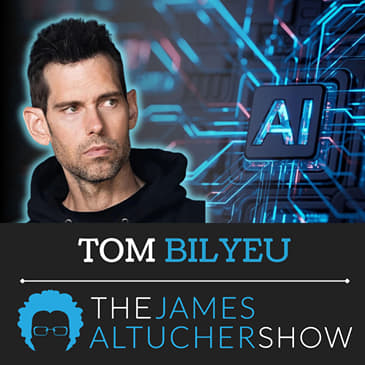



Before building anything, Tom says you can find out in about a day whether people care about the problem, and he explains how to run that test with AI.
A Note from James:
Back in the ’90s, I built websites.
I actually built American Express’s first website.
And I remember walking into places like JPMorgan and saying, “Eventually, every one of your customers is going to interact with you through a website.”
They laughed at me.
They weren’t stupid.
They just didn’t want it to be true.
I think about that a lot right now.
When I was a programmer, a good day might have been 100 lines of working, debugged code.
With AI, I can do something closer to tens of thousands.
Tom Bilyeu has spent his career reinventing himself.
He helped build Quest Nutrition. Then he built Impact Theory, which came out of nowhere and became one of the biggest shows in its category.
Now he’s building a video game called Kyzen—a massive, procedurally generated world—and using AI throughout the process.
So I asked him the question I was honestly a little scared to hear the answer to.
You’re 45. You’ve got a mortgage. You’ve got kids. You’ve built a career.
And AI is coming for your job.
What happens?
Tom did not comfort me.
He said history suggests some people will lose their jobs during a technological transition and never really recover.
That happens.
But then he made a distinction I think is much more useful.
It isn’t necessarily about age.
It’s about what kind of person you are when the world changes.
Do you look for the opportunity?
Or do you spend all your time looking at what you’re about to lose?
And Tom also gave me one question I’m absolutely stealing.
When he uses AI to evaluate an idea, he doesn’t ask:
“How do I make this succeed?”
He asks:
“Why is this going to fail?”
That changes the entire conversation.
This is Tom Bilyeu.
What You’ll Learn:
- Why Tom believes AI is eliminating many traditional technical and financial business moats.
- How he uses AI to compress product research, testing, development, and execution.
- Why one of his most useful AI prompts is: “Why is this going to fail?”
- What he would do today if he were 21 and starting an AI-enabled business from scratch.
- How mid-career workers can position themselves before AI changes their jobs.
- Why Tom thinks brand, distribution, network effects, and judgment become more important as intelligence gets commoditized.
- What previous technology booms may tell us about today’s massive AI infrastructure investment.
- How Tom built Impact Theory by finding white space in a crowded market—and how he is applying the same principle to Kyzen.
Timestamped Chapters:
[02:48] A Note from James
James connects the current AI transition to building websites in the 1990s and introduces Tom’s rule for challenging an AI-assisted idea.
[04:28] What Tom Is Building Now
Tom updates James on Impact Theory and introduces Kyzen, the massive procedurally generated game his team has been developing.
[05:39] What Is a Moat When Anyone Can Build Software?
James asks what protects a game—or any software company—once technical difficulty stops being a meaningful barrier.
[06:14] Brand and Network Effects Replace Technical Advantage
Tom argues that differentiation will increasingly come from audience, ecosystem, distribution, and the relationships surrounding a product.
[08:17] Winning in an Avalanche of Content
Impact Theory’s decade of competing on YouTube becomes Tom’s model for surviving a future where AI creates an overwhelming supply of games and media.
[10:04] The AI Wake-Up Moment
Tom remembers watching a game-development process that once required several people and months of work collapse into a single afternoon.
[11:51] Does AI Actually Create Better Businesses?
Tom says AI helps entrepreneurs get to revenue faster and with fewer people—but it does not automatically solve product-market fit.
[13:31] What Tom Would Do at 21
He lays out a practical approach to using AI as a researcher, product-development partner, and accelerator.
[15:40] The People-Pleasing Problem
James warns that AI can enthusiastically help build a terrible idea if the user never challenges it.
[16:24] “Why Is This Going to Fail?”
Tom explains how he prompts AI for disconfirming evidence, skeptical arguments, previous failures, and first-principles analysis.
[18:18] Use AI to Understand the Person Across the Table
Tom shows how founders can research distributors, customers, decision-makers, and the incentives driving them.
[19:25] Better Inputs Create Better AI Outputs
A frustrating design exercise teaches Tom that vague stylistic references produce derivative results; understanding the underlying vocabulary produces more original work.
[23:12] When Everything Becomes AI-Native
Tom predicts that the next stage will come when software, appliances, development environments, and everyday tools are built around AI from the beginning.
[25:40] Your Old Advantages Just Disappeared
Tom describes the unsettling realization that intelligence, speed, technical skill, and capital may no longer provide the same protection they once did.
[27:24] From 100 Lines of Code to 50,000
James compares his early programming career with the amount of work modern AI tools can generate.
[28:25] Today’s AI vs. Artificial Superintelligence
James and Tom distinguish the limitations of current models from the far more disruptive future systems AI skeptics and safety researchers worry about.
[30:00] What Happens to the 45-Year-Old Worker?
James asks the question directly: if you’re mid-career with a family and AI threatens your job, what happens next?
[32:01] Money Doesn’t Solve the Meaning Problem
Tom argues that even if governments eventually cushion widespread unemployment, people will still need purpose and identity.
[33:10] Be the Last Human Standing
As long as AI remains a tool, Tom says the advantage goes to the human who learns how to use it aggressively.
[34:16] What Should You Learn Right Now?
Tom recommends experimenting with the strongest available AI tools toward work that is economically valuable.
[36:17] James Remembers the Early Internet
Companies once laughed when James told them customers would eventually interact through websites. He sees a similar resistance happening now.
[37:18] Reinvention Is a Personality Trait
Tom argues that disruption rewards people who become excited by learning the new thing instead of focusing exclusively on what they may lose.
[38:00] Is the AI Infrastructure Boom a Bubble?
James and Tom discuss falling inference costs, enormous data-center investment, debt, and the historical pattern of infrastructure booms.
[42:35] Even If the Bubble Bursts, AI Still Wins
Tom argues that AI is already useful enough to spend years transforming existing industries even if model progress stopped tomorrow.
[43:11] Which Jobs Last the Longest?
Physical work may resist automation longer, but Tom sees embodied AI and robotics eventually reaching even highly skilled trades.
[45:48] AI, Medicine, and the Human Layer
James uses a medical story to explore the difference between AI’s analytical ability and the continued need for human judgment, care, and communication.
[47:53] How Impact Theory Broke Into a Crowded Market
James asks how Tom built a major media brand after being told podcasting was already saturated.
[48:37] There Is Always Room for Better
Tom explains the principle behind Impact Theory’s early growth: find something valuable competitors are not doing and execute it at a higher level.
[50:24] Find the White Space
High production value helped Impact Theory attract guests before it had a large audience. Tom says every new entrant needs to identify its own equivalent advantage.
[51:31] Building Media With AI
Tom describes using AI for analytics, trend detection, scripting, content generation, and marketing strategy around Kyzen.
[53:39] Testing Kyzen Before the Public Sees It
Tom explains why the team is starting with trusted testers before expanding access—and why brutally honest feedback is welcome.
[55:35] Why It’s Called Kyzen
The name comes from the Japanese concept of continuous improvement, deliberately respelled so the project could be trademarked.
[56:18] Constant Improvement
James connects Kyzen’s name back to Tom’s career of repeated reinvention and closes the conversation.
Additional Resources:
- Impact Theory — Official Website
- Project Kyzen — Official Website
- Tom Bilyeu — YouTube
- Quest Nutrition
- Claude — Anthropic
- ChatGPT
- Unreal Engine
See Privacy Policy at https://art19.com/privacy and California Privacy Notice at https://art19.com/privacy#do-not-sell-my-info.
[00:00:00] Today on The James Altucher Show. Well, if you're in your mid-40s, history says that you are going to lose your job and you're not going to recover and it is going to be brutal. And I think lying about that isn't going to help anybody. So every time we've gone through a major technological revolution, there is a type of person who is unwilling or unable due to intellect. They're unable to exist in the new economy. And it is a tragedy.
[00:00:27] The danger is, and you have to be very careful as a user of this danger, is that the AI likes to please. They want to please you so you keep interacting with it. If you're looking for the ways that it can improve your life, financially, emotionally, you will also find that. It is the most extraordinary tool humans have ever had access to. Some people will avail themselves and others won't. And the people who do will win and the people who don't will be left behind. It's just that simple.
[00:00:57] This isn't your average business podcast and he's not your average host. This is the James Altucher Show. So back in the 90s, I built websites. I did American Express's first one actually. And I'd walk into JP Morgan and say, you know, every one of your customers is going to deal with you
[00:01:26] through a website. They laughed at me. Look, they weren't stupid. They just didn't want it to be true. I think about that a lot right now. Like when I was a programmer, a good day was 100 lines of working code. With AI, I can do, I don't know, maybe 50,000. Tom Bilyeu kind of keeps reinventing himself. First Quest Nutrition, then Impact Theory, which, I mean, came out of nowhere and became one of the biggest podcasts out there. And now he's building a video
[00:01:55] game the size of planet Earth with AI. So I asked him the question I was honestly kind of scared to hear the answer to. You're in your mid-40s. You've got a mortgage. You've got kids. AI is coming for your job. What happens? And he didn't comfort me. He said, look, history says you lose that job and you don't recover. Every big technology revolution leaves a group of people behind. But then he said something that made me feel better.
[00:02:22] It's not really about age. It's about like what kind of person you are, whether you look for the opportunity or only the downside. And by the way, he also told me the one question he asks AI before he starts anything. It's not help me succeed. It's tell me why this will fail. I'm stealing that. Okay. This is Tom Bilyeu.
[00:02:51] Tom, first off, I think it's been about six years since we last ran into each other. I was, I recognized the studio. I was at your house. I was at the studio. How are things going? Good, man. Good. The core of what we do is our content. Content is singing. We've got a network now. I don't know if you know who me and Bialik is from the Big Bang Theory, but we rep her. We rep some other people. So that's been great. Our game that we've been developing now for almost four
[00:03:17] years comes out in 13 and a half months. So I'm very excited about that. So yeah, things are good here. Tell me about the game and then I want to talk about AI with you. Yeah. So the game is what's known as a craft like. So it's in the genre of Minecraft, though it plays very differently. So we're like a high mobility Minecraft where combat and creature capturing is like the core of
[00:03:41] the loop. Very expansive world, all procedurally generated. So every world is unique. It's the size of planet Earth and not in a boring way where it just repeats and repeats and repeats. So yeah, we think we've got something pretty special and we're very excited to hit the December date that I'm going to need every minute of that time. Well, let me ask you, like, I'm just going to jump right into some AI stuff and then we can go further. Like if I'm using Claude and I say, make me a Minecraft
[00:04:10] with these features, you know, it'll take an hour or so and maybe I'll do some iterations, some looping on it, but it'll do it. And this is kind of a more general question, but A, what is going to make your version of this special? And B, given that a big part of the moat of software has completely been eliminated, which is kind of the technical difficulty of creating a large software program, where is your moat in this game? Well, in the age of AI, nobody's going to have
[00:04:38] a technical moat or a spending moat anymore. It's going to be brand, it's going to be network effects. And so part of the question is, will we be out early enough such that even people that are armed with AI, because we obviously use AI, so anybody that's competing against us is using the same tools. So whatever lead we already have, at least we've got that working in our corner, but it's going to be up to us to be better integrate one, just the game is more unique.
[00:05:06] That moat doesn't last long, but the game being more unique that we can establish a brand. I think we understand content better than 99.99999% of game developers. So leveraging our content to build an ecosystem around the player base, allowing for modding, just making smart decisions there so that we can build a player base that becomes part of the network effect that becomes the brand.
[00:05:30] So that's the game. But AI is existential. So it really is like looking at an event horizon and saying, okay, I know that to some degree, I'm being very skeuomorphic. And I'm thinking of the world before AI. And I'm trying to imagine what it looks like with AI when in reality, the world is just going to be so fundamentally different. What are the revenue models? They will almost certainly be different.
[00:05:52] Does the game itself become very narrow in its attraction that you find that you have a small player base, but it's extraordinarily deep. And for whatever reason, they picked your game and now they're, you know, they're there and you've got them, but it's not going to be this sort of massive aggregator of players like you see now. All of that is very possible. And I don't think anybody really
[00:06:17] knows. So our method is integrate AI as fast and as deeply as we can make sure that the game feels like an extension of human creativity and does not feel in any way, shape or form like AI slop, and then get to market as quickly and as high of quality as we can, and then be adaptive because we know something is going to change that we can't yet anticipate. I guess getting to market is the key point. Like you have to be able to market and because software is now disposable, anyone can make
[00:06:46] software one day and throw it away the next. There's so many people saying, oh, I have a game, I have an app, I have a this, or I have that. How do you market fast and furious and broadly enough that you can get a degree of confidence before you spend that kind of money that, hey, you're going to create, you know, a universe for your game? Yeah. So a big part of that question for us is a very fortunate that we've spent the last 10 years mastering YouTube. And the fact that we understand
[00:07:15] the algorithm, we understand how to compete in a space where the daily deluge of content is so extreme that the only thing that you can hope to do is understand the algorithm well enough to make content that the algorithm likes so that enough people are going to see you and then deliver an experience that they want to come back to. And so I imagine that that's exactly what's going to happen to gaming, whether it's on Steam or elsewhere, there'll just be such an avalanche of content
[00:07:43] available to you. It becomes how do you become the one that they see? And then when they try you, what's going to make them stick around? And so it is the very problem that we've had to master on the content side over the last 10 years. So we feel very confident in being in that kind of world, whether it's gaming or not. If the world had already been AI-ified four years ago when I started development, then my approach in the beginning probably would have been very different.
[00:08:08] But now that we're as far down the road as we are, it really just becomes a game of costs are going to get cheaper every day. There's going to be more competition every day. And so you've got to focus on cutting through the noise and making sure that your game is sticky so that players stay around. So look, obviously, we've been circling around the issue of AI. I sort of feel right now the world
[00:08:32] is divided into two groups. The people who have used AI to take three months worth of work and squash it down into 10 minutes and the people who will eventually do that. And the first group is about maybe 1% of all AI users out of the 2 billion or so AI users. And then the second group is 99%, which kind of explains all the math about how we get to this massive infrastructure build out and all
[00:09:02] the costs and stuff associated with it. And I know you may have some differing opinions on this, but what was your sort of wake up moment where you were using AI and you're like, oh my gosh, the world's different? I've really had that moment many, many times. But the first one was when we output our first asset that we could actually drop into the game. And so we went from a cycle that would take three months and like four to five different people having to touch an asset before we could get it in the game
[00:09:31] to do it in an afternoon was the most absurd thing I'd ever seen. And the quality obviously wasn't there, but it's very easy to go, we'll just project out six months, a year, two years, three years. And it's like, it improves so rapidly that only a fool looks at that and goes, ah, well, this is bad. It's like, well, it's bad today, but it's going to get better every day. And it really has. So for us,
[00:09:57] it's making sure that we're just staying on top of a way to translate those revelatory moments where you're like, oh my God, everything is different now into actual pipeline. Because it's one thing to see something that's really cool. It's another to go, okay, can we actually make that production ready? Yeah. And now you've also been, look, giving a course to startup founders on how to basically use their AI to ramp up to a single or double digit millions revenue business. Have you seen
[00:10:25] an example of a startup that quickly, boom, using AI gets to single digit millions in revenues? You're not seeing leaps that fast, but we are seeing entrepreneurs who would have been able to build a business without AI, leverage AI to do it faster and cheaper. So we've certainly seen the sort of call it the distance between your first sale and your first $10,000 month has shrunk dramatically. We've had many of those kinds of successes,
[00:10:54] but AI is not good enough. And it's commodified enough that until people are able to create a proprietary layer between them and the commodified intelligence where it's like, okay, this gives answers that is a combination of me and the AI. I don't think you're going to see sort of runaway things like that. It's just elevated the expectation. It's improved the ease with which people can do
[00:11:19] some of the more basic stuff. So I think first you see just reduction in staff in terms of what you need, but racing to higher revenue really is about solving a unique problem. And AI isn't good enough yet to reach into the ether in a way where you aren't already telling it what to look for and finding a unique idea that it's only handing to you that so adequately solves a problem that people have been screaming to have solved that your business just explodes. To get that kind of explosive growth, you really
[00:11:48] have to nail the product market fit and timing. And so AI is not solving that problem yet. I agree. So like, what would you do? Let's say you were 21 years old, you're energetic, you're entrepreneurial, you're excited, you know, AI inside and out, like you don't need to be taught about AI. What would you do right now to kind of start a business? Okay, so the very first thing I'm going to do is use AI as a thought partner to find product market fit.
[00:12:16] So I'm going to run through, I think of it as a researcher, I'm going to give it that identity, I'm going to tell it exactly what I wanted to do. Tell it, hey, I'm trying to find pain points that people already know they have, that there's evidence of whether it's somebody is doing a cobbled together version of this. There's people like it just used one of my past companies, Quest Nutrition. It's like, oh, are there people talking about they're making a product at home because there's nothing on the market that meets their need for the flavor profile plus the nutrition
[00:12:45] profile? Yes, cool. There's this product, whatever it might be, right? So for us, it was protein bars, whatever that answer would be today, you get that answer. Then you create one that's like, now you're a food scientist. And it's like, I want you to help me identify the ingredients that I'm going to be putting into this. And then it's like, all right, now I want you to help me with the logistics of tracking down who sells these ingredients. And so the time window goes from
[00:13:11] six months to run through that initial phase of getting actual ingredients in your hand and making something down to you could do it on a three-day weekend easily. And so that is the radical change. And so you're talking about what I teach entrepreneurs. What I teach is just the five basic things you have to do to get to what I call a minimum viable test. So before you build the product, just prove that people care about this problem. You can do that very fast, literally in a day,
[00:13:41] and then take that information, run the test as a lead magnet or something like that. Make sure that people actually care about the topic. Then we build the product. Then we do our minimum viable product, get it out into the market. It's really about time compression and not needing as many people because the AI has been trained essentially on all human knowledge. Yeah, no, it's fascinating. And A, I like the product market that using the AI for that. The danger is,
[00:14:09] and you have to be very careful as a user of this danger, is that the AI likes to please. They want to please you so you keep interacting with it. So if you say, I have an idea, I want people to visit Saturn on vacation, it'll say, great idea. Let's start working on it and start brainstorming with you, even though it's like an insane idea. So you just have to be very careful that you're not smoking crack, that you like challenge it. Like you have to disagree with it, even when you don't
[00:14:36] disagree, just to see what it says. And so you gotta be very careful. Like what would you do to really find product market fit using AI? So there's a couple of things that I actively do. And that's one, I give a documentation that explains how I want it to work with me that I have no interest in being agreed with. I only care about what is right in the marketplace, meaning I have a goal. This thing either moves me towards that goal or it does not. I need disconfirming evidence. I don't
[00:15:03] just want to be told the good things. And then one of the most important questions you can ask an AI is why is this going to fail? Not help me make sure that this is going to succeed. Tell me why this is going to fail so that it will take the time to outline all of the gotchas, all of the problems that it sees, et cetera. And then if I know the pushback to give, I'll just give it directly. But if I don't know the industry or the product or whatever well enough, I'll say, what are the smartest minds who think this idea is stupid? What do they say? What's their logic? Why do they
[00:15:31] think this is a terrible idea? And so then it will start giving you threads that you can pull on. Now, I remind people all the time, the smarter the person, the smarter the AI. And so if your AI is giving you terrible answers and you think the AI is dumb, I've got some really bad news for you. So that comes down to how are you pushing it? How much do you know that you can say, no, no, no, hold on. That doesn't make sense. They're even just thinking from first principles. That doesn't make sense. That's another thing in my training document is to tell it to always think
[00:16:01] up from first principles. Don't just give me the summation of papers that have been written on this topic because if it doesn't violate the laws of physics, it is possible. We just have to identify where does this fall down? And so I'll often ask, okay, has anybody attempted this before me? If so, why did they fail? And so it oftentimes is aware of people that have tried to do this or people that have been commenting about what's hard, what challenges remain. And so you can get a pretty
[00:16:28] clear picture if to your point, you don't buy into the, oh my God, yes, let's go to Saturn. As long as you protect yourself from that, AI is unbelievable. And then like looking at your business, I'm imagining a big part of your business was essentially getting shelf space, which is almost like human to human, knock on doors, get people to try the product. You know, it's hustling and AI is not going to do that for you,
[00:16:54] but can you use AI to sort of identify the people you need to speak to or the channels that might be better than the channels you're thinking of? Absolutely. You can do everything from identifying the people where they're at, who the demographics are, what would make that person inside that company a hero? What are going to be the, you know, solutions that you're offering that person, whether it's like you're going out to a distributor. Okay. I'm talking to a distributor. What are their pain points? Like I've never been a distributor, so I don't know what those guys care
[00:17:23] about. So what would my product need to offer them that would make my product the most selfish thing that they could pick up? How do I frame that? How do I talk about it? What do I lean on? And so it's incredible for all of that stuff. If you think of AI as like, it's your smartest friend that's trained on the exact thing that you need to understand. But at the same time, you've got to tell it what you're trying to do. What are you trying to accomplish? What are the likely problems? What are you running into? Give it more feedback. All of that stuff goes a very long way. And then
[00:17:50] just remember how AI is trained, right? It's finding patterns in human data that's been put on the internet. And so if it's gotten like, if the way that you've prompted it sends it off to find answers on Reddit, you're probably in trouble. And so you've got to get good at prompting it in a way that's likely to return the answers that you want. And one of those ways, I learned this the hard way in asset
[00:18:15] creation for a video game. I just couldn't get anything but derivative like designs. And I was like, this is what why everybody hates AI. It's just giving you a copy of something that's already existed. And so then I realized, okay, hold on a second. I don't know the language of design. Therefore, I'm actually the one causing this problem because I'm giving shortcuts like, give me something with like a Pixar profile right now. It's like, cool. It's going to give me things
[00:18:40] that look like Pixar. But if on the other hand, I understand the things that make up the proportion line weight, like here's a big one. Tapered limbs with constricted joints. If you're trying to make something look muscular, use that prompt. High-waisted, nine-to-one head height body, right? You start getting into like very logistical descriptions. Now you can just do what an artist
[00:19:06] does, which is like, okay, I want this kind of roundness or what they call thick-to-thin design proportions, but I want to mix it with like a really angular vibe, right? And so now you can create something that hasn't existed before because you actually understand the ingredients. If your entire frame of reference is final outputs, everything you do will be derivative. Yeah. It's so interesting because as each generation changes, like for instance, what you just
[00:19:34] described for like a, let's say a muscled character that I feel like, let's say last generations, you know, meaning six months ago, six months ago, AI, you would need that. But then as AI has gone from a trillion parameter model to like the latest ones, 10 to 15 trillion parameters, it sort of knows now what you mean and reasons, oh, he probably really means this. And it's getting there.
[00:20:01] But I've, I've found that it's still ridiculously derivative and it's very hard to get to what's in your head until you break it up. And so what you'll find is it will give you extraordinary images, but there will be aspects of it that just aren't right. And as you try to change those, it breaks something else. Yeah. And so there's a maddening quality when you try to describe
[00:20:24] like, I want something that's like Pixar, but has like a really dark edge. Okay. It'll give you something. You'd be like, oh my God. Okay. Yes. You're like in the genre, but I see a little too much, you know, whatever. Like that actually looks like a character from one of their films. I've got to tweak that and I'm trying to add that. And that's where you can end up in these doom loops because when you give it a reference like Pixar and until you stop saying Pixar, it's just queuing off of
[00:20:54] those things. It's going to give you those things over and over and over and over. And so if the very thing that you're trying to get rid of is one of the things it thinks is definitionally Pixar, now you're in trouble. Like even just the fact that you can prompt it for three-dimensional images and get a nice design without using, you know, your own 3d, you know, CAD software or whatever is very interesting. So where do you think, where do you think in society, some of these pain points
[00:21:22] are going to be solved by AI in the near future? And again, assuming that only 1% of people are really using AI to its medium level capabilities. Well, the big thing for me is as it gets integrated into things, that's going to make a world of difference. So I'll give you a specific example from my world of game development. So right now, Unreal Engine 5 obviously was designed years and
[00:21:46] years ago. So while AI can help you, AI moves very slow. It has a hard time untangling some of the things that are called blueprints, but the Unreal Engine 6 is designed to be AI first. And so now the language, the integrations, everything will be designed to be much, much, much faster, far more elegant with AI. And I think that you're going to see that spreading
[00:22:13] across everything from the different applications that you use all the way to your coffee machine. And so AI is just going to be, or the things you interface with are going to be designed from the ground up to interface with AI or to use AI or probably both, where it's like you're using AI to develop this thing that has AI inside of it and therefore can run the intelligence of a coffee machine in a way that's like, okay, detect when they usually use it. Can I start heating the water up
[00:22:40] five minutes before their typical time? It's a Tuesday. They're normally hereby, right? So you're going to get stuff like that. So making the world have the technological infrastructure to work with AI will be a sort of fast moving revolution that'll probably take the next three to five years. And then on the other side of that is just, it's de rigueur. You would never think
[00:23:05] to write code like that would just be so bizarre is like, okay, I guess I could go in and do that. But I've got the thing that just lets me say, this is what I'm trying to do. Change it like this, tweak that. And for anybody that hasn't written an application with vibe coding yet, that is, it will change your life. Like the first time I wrote an with AI, obviously, but I wrote a piece
[00:23:29] of software that actually interfaced with Unreal Engine to allow me a non-technical person reduce my time to make edits from call it a 24 hour cycle because I had to document it, send it to the tech team. The tech team had to do it, make a build, send it back to, I could do it in 30 minutes is
[00:23:53] so insane that you just go, oh wow, I see how fast this is all going to get because these are the clunky tools. This is the dumb AI, right? It's just going to get better every day. And to think that we're already this far and look, it does, the closer you are to this, the more it freaks you out because you're like, this is incredible. It's only going to get better. And all of the moat that I had before, because I was smarter, faster, more disciplined, better capitalized, whatever, poof,
[00:24:20] it's all gone. But if you instead just look at this extends my abilities a hundredfold, I mean, it's just crazy. Take a quick break. If you like this episode, I'd really, really appreciate it. It means so much to me. Please share it with your friends and subscribe to the podcast. Email me
[00:24:42] at alcatra at gmail.com and tell me why you subscribed. Thanks. Look, most people still treat AI like it's some distant future thing, right? Meanwhile, the smart companies are already using it to change how they actually work every day. I mean, they're asking better questions, making faster decisions,
[00:25:10] and handing off the routine stuff so their teams can focus on what actually moves the business. That's basically what NetSuite Next is built for. It's the next generation of the business management suite trusted by over 44,000 companies with AI woven into the tools you already rely on. It surfaces insights when you need them, puts agents to work on the repetitive tasks and problems, and lets you ask complex questions about your business in plain English, like you're talking
[00:25:36] to a sharp colleague, you know? But technology is only half of it. AI is also changing how people and teams work together. So that's why I want you to download this new guide, Aligning for the Agentic Era, How AI is Changing Everyday Work. It's free right now, and it shows you how this shift can play out across your organization and how you can actually prosper from it. Honestly, I use this, and you should too. If your revenues are at least in the seven figures, get your free guide at
[00:26:03] netsuite.com slash James. Netsuite.com slash James. It's crazy. Like, look, I spent the first probably 15 years of my career as a software developer. You know, I built a website design company, but I was like the software side, and I started a hedge fund where I was using basically
[00:26:27] AI software that I wrote to help run the hedge fund. And this is a long time ago. And a good software developer, the rule of thumb is can write 100 lines of debugged code per day. Using AI now, I could write probably 50,000 lines of debug code a day. Like, it's unbelievable. And by the way, though, it's not necessarily smart. It just works really hard. And it knows a lot. It knows all the
[00:26:55] tricks, so it knows how to do it really fast. To your point, it still needs a lot of human guidance, which is why, like, when people say, oh, AI is going to destroy all of humanity, I kind of call bullshit on that because it's really stupid in a lot of ways, too. Unless, like, a human makes a mistake, I don't see how AI is going to do any damage at all. Well, yes. If you're looking at what we have today, that is obviously true. When you hear people freaking out, they're thinking like a sci-fi
[00:27:22] writer. They're projecting out into the future. And whether they know it or not, their assumption is that artificial superintelligence comes into existence. It's better than us at everything, including having its own motivation, its own sense of what we're trying to accomplish. Nobody needs to tell me what to do. I've identified a gap in the market. I know what to build to get there. I know how to write the lines of code, the marketing, everything. And in their imagination,
[00:27:48] the AI truly is better than them at all of that, and they will only slow it down or mess it up. In that scenario, which unfortunately could become a reality, that is, it is destabilizing to the society that we know today. It doesn't mean it's not a better version, but it does mean that the world that you know and live in now is going to go away if that becomes the thing. And that's assuming,
[00:28:13] of course, that you're able to constrain it or align it such that it doesn't become a danger to humanity. There's plenty of people making noise that you're not going to be able to do either of those things. And so now they're imagining, okay, first it's going to take my job and then it's going to kill me. And I think the more people interface with AI, the more likely they are to understand where it falls down. And the less they interface with AI, the more likely their
[00:28:40] imagination is to run away with them. And so given that whatever 98% of people have little to no relationship with AI, they're all just freaking out. Well, okay, let's say you're, we've done the 21-year-old. Let's say you're the 43-year-old mid-career and you're afraid AI is going to take your job. Is it like, what industries do you think go first? And what do you do about it? Well, if you're in your mid-40s, history says that you are going to lose your job and you're
[00:29:07] not going to recover and it is going to be brutal. And I think lying about that isn't going to help anybody. So every time we've gone through a major technological revolution, there is a type of person who is unwilling or unable due to intellect to exist in the new economy. And it is a tragedy. Even if you look at the internetification, there are credible people that say part of the reason deaths of despair have been on the rise is because those are the people that the internet took their
[00:29:34] blue-collar jobs and or their low-level white-collar job. They just, they couldn't adapt, couldn't or wouldn't adapt. And so it became about drugs and alcohol and just checking out of the labor force and life is not good. And we saw the same thing with the industrial revolution. We saw the same thing with the electrification. And so there is going to be some percentage of people that will refuse or be unable to step into a world with AI. And it, it happens every time we have a
[00:30:04] revolution like this. Now to anybody that is able to get themselves in a position of either excitement to change or just embrace, I have to change because I need to remain economically relevant. They'll start using AI as fast and as furiously as they can towards a goal they actually care about. But I find no matter how self-evident that is, no matter how much adults are actually capable of change, the vast majority do not. So we will have a generation of, I think you're being generous by
[00:30:33] saying 45, but we'll have a generation of people that have aged out of making the transition and it won't be pretty for them. Okay. So I'm that person listening to this and I'm like thinking, oh, I should just kill myself now. What should I do to stop this dismay from happening? Like understand that there will be some sort of UBI additional programs and that the real thing you have to worry about is meaning and purpose. Because the only reason that you would be even
[00:31:02] contemplating something that horrible is that you don't think you'll ever be happy again. And there's no way for that person to square that with odds are right now, they want to retire as quickly as they can. And so it's like, well, if you're looking to retire as quickly as you can, and you understand, let's just say that there's an ungodly number of jobs that are lost, the government is not going to let you turn into a revolutionary force and there's going to be blood in the streets. They're going to make sure that you get taken care of if for no other reason than
[00:31:29] to pacify you. And so now it's like, what are you going to do with yourself? Because having enough money to live and to eat does not solve the meaning and purpose problem. And so you're still going to have to address that. Right. So, but if I'm thinking, oh my gosh, I've got a mortgage, I've got three kids who may or may not go to college, you know, depending on how the world use that 10 years from now, you know, where can I start positioning myself? Like, what should I learn?
[00:31:55] What should I do? Obviously, okay. Be the last man standing. That's always my thing. So right now, AI is merely a tool. AI without a human, as you said, is going to glitch out. It's not going to be very useful. AI in the hands of a human though is extraordinary. So make sure you're the human that's using AI. All the people that are taking pride and like, I don't use AI and fuck that. It's all garbage. You guys are fucked. Like that is such an idiotic approach to this. So AI is the single
[00:32:22] most powerful tool humans have ever had access to. If you choose to not avail yourself of that, you will only be able to work at companies that sell products to people under the guise of no AI was used in the making of this product. There will be a niche for that, but it will be a niche. And so should you choose to limit your life in that way, that's up to you, but that is actively unwise. Yeah. So again, like from zero to founder, like your course on this stuff,
[00:32:49] how can I start equipping myself? Let's say I'm the 20 year old, one year old with nothing or the 40 year old with no knowledge. And I want to start, what can I start doing? Get a max payment plan with either Anthropic or open AI. They're just the two best right now. By all means, switch. If something comes along that's better, I get the best one going to be between 200 and $500 a month and start
[00:33:12] trying to either do your job better with AI or start a business leveraging AI comes down to their vision, their risk appetite, whether they like being alone or whatever, but maximize your use and experimentation of AI towards a goal that is monetizable. So whatever you're doing now, can it be done with AI or is AI going to eliminate it? Like I would not want to be spending my time trying
[00:33:37] to become a better Uber driver with AI. That's just all going to go away. So what is the thing that I'm doing that I can use this for, get good at it? Yeah. And look, I think, I think AI is particularly good at some things for AI is good at making a basic website. So it's possible to prompt into AI, like, Hey, this is my zip code. Find all the law firms or dental offices in my area that don't have
[00:34:06] websites, make a website for them right now. And I'll just go knocking door to door and saying, Hey, I have your website. It's yours for like $400. Like there's just, I'm not, I'm not saying that's a good idea or a bad idea, but there are things you could think of that are probably fairly basic that do involve a little bit of hustle, which AI will never be able to do, where you could make a business. You could start a business. A hundred percent. This is where it comes down to. If somebody
[00:34:32] has the intellect and they're willing to do it, there will be no shortage of opportunities. I am desperately trying to hire people that are good with AI. So it just comes down to right now, there's such a weird emotional reaction to AI where you get a huge swath of humanity that just opts out. And they're like, I'm not going to do it. I won't work for a company that uses AI. I'm not going to use AI. And it's like, wow, that is not a tide I'd want to be swimming against.
[00:34:58] Look, it almost feels weird saying it was a long time ago because I was, I was so young and so excited and so happy every day when the internet was first beginning its rise. I'd been using the internet since the eighties. And then of course the web started in the 91 and then was really becoming more mainstream around 96, 97. And of course, Oh five, it really became mainstream with
[00:35:20] Facebook and social media. But I was just so excited to participate in this, this new technology. And, and it really was changing everything. Like I would go visit, you know, I was, I did American express.com. I did their first website. I would visit like JP Morgan and they would say, what do we need a website for? And I would say, all of your customers are going to interact with you
[00:35:44] on their website and they would just laugh at me and things change really fast and it's scary, but you didn't have to be young to participate in what was going to happen. You could have been agreed. Agreed, man. Look at you. You're doing your AI thing. You're not in your twenties anymore, but that that's what is, it's a type of person that they're always going to reinvent. They're always going to want to learn the new thing. They're going to want to push forward. They find that excitement,
[00:36:09] they feel it and they write it. And that's why I worry that so much of this is personality traits that don't mind moments of disruption that are looking for the opportunity and not just the downside. It's like, whatever you look for, you're going to find. If you're looking for all the things to be terrified about AI, you will find them. If you're looking for the ways that it can improve your life financially, emotionally, you will also find them. It is the most extraordinary tool humans have ever had access to. Some people will avail themselves and others won't. And the people who do
[00:36:38] will win and the people who don't will be left behind. And it's just that simple. And, you know, I don't know if this is a question you've thought about or care about, but given that AI is getting cheaper. So because it's almost a commodity, what ChatGPT and Claude and Throbic are offering, they're just saying, Hey, we got, we got trillions of pieces of data. We crunched into an AI model and now we want to give it to you as, as, as much as we could
[00:37:08] charge, but because they're all competing and because we all have access to the same data and the same machines. If you have the money, the price is going down and down. It's a, it's a death spiral down. So as price per inference or price per AI output gets cheaper, what happens as all these companies, the hyperscale, Amazon, Microsoft, Google, Facebook, they're spending hundreds of billions of dollars, trillions of dollars to build up the data centers and the infrastructure. When does this
[00:37:37] collide into something bad or does it like prices going down, but trillions being spent to deliver the outcome of those prices? When does that become a problem? Okay. Well, here's where history will be our best guide. Unfortunately, what history tells us is every time there's a revolutionary new technology that requires massive infrastructure build out, the initial wave of people that are pouring their money in end up losing their money. And it's the
[00:38:03] second generation known as the inheritance generation that picks up those companies and that infrastructure for pennies on the dollar. And then they're actually able to monetize it. So if that pattern plays out again, cause it played out in the railroads, the canals in the UK, the railroads in the U S played out in the internet, obviously the industrial revolution. It's just like,
[00:38:25] this is the game. So I'm fully expecting there to be a pretty substantial correction within the investment and debt side of AI. And if you're looking at what's going on in private credit right now, which is like hyper exposed to the riskier side of debt in AI, you're starting to see, I think it's 1300 basis points spread between the treasury and some of these bonds. So people that are
[00:38:53] being asked to buy the debt of these hyperscalers, they're all saying, bro, I'll do it, but you got to give me 13, 15 points more than I would be paying for something in the U S government. So it's like, yo, we're certainly in junk bond territory. We're racing towards distressed. You've got blue owl sending up like alarm bells saying, okay, I know we told you, we would let you take your money out, but we didn't think you guys would get spooked and try to get
[00:39:22] your money out this fast. So actually psych, just kidding. We're not going to let you take your money out, but don't worry. It's not a problem because the loans are still solvent, but people keep knocking saying, Hey, you told me I could get my money out. I want it. So there's a lot of question marks about that. The New York fed was going around auditing all the banks saying, Hey, just, just out of curiosity, how exposed to private credit are you? So there's clearly some unease that people have about what's going on in the private credit market,
[00:39:48] which you can effectively take as a bet on all these AI data centers and all the debt that's accumulating. But having said all of that, I think it was Anthropic that just posted like another 5 billion in growth month over month. So it's not like the money isn't coming in. I mean, they're bringing in revenues at like historic levels. It's crazy. It's just a question of,
[00:40:15] is it fast enough? I mean, Anthropic now is the fastest growing company in history in terms of revenues. So wild. Yeah, it's wild. I mean, it's insane. And, and even like you look at these, the Chinese open weights companies like Moonshot AI, which makes the open weights model Kimmy K3, which is right below, let's say Anthropic and open AI. They're on pace for over a billion dollars in revenues. I don't even know who's a single buyer. So I don't know, I guess in China or in the
[00:40:42] US, I don't know, but you're right about kind of, if you go from the railways or you go from the internet, but I'll say it's not all bad in the sense that the people who made the steel that turned into the railroad tracks, they made money. They stayed at Memphis. And the people who transported goods across those brand new, you know, railroad tracks, they made money. So yes.
[00:41:06] And the railways ended up transforming every nation that used them. Yeah. AI is going to be the big deal that everybody expects it to be. Cause even if it never got any better than it is today, you'd have at least a decade, maybe two of it getting just integrated into everything and making everything better intelligence or AI is intelligence itself. And so realizing that what is it that makes somebody powerful in real life? How smart are they? And so the fact that we can get commoditized
[00:41:34] intelligence is insane. So yeah, it is already, no matter what happens, bubble bursting doesn't matter. This is going to transform everything we know about the world. What jobs don't get affected
[00:42:01] by AI? Like do plumbers become more valuable than ever? Well, because I think ultimately intelligence will be embodied and hyper dexterous in the same way that a human is. I think on a long enough timeline, nobody is quote unquote safe. So it really becomes a question of will AI remain a tool and humans get to direct that tool. And most importantly, will humans be able to adjust the weights themselves so that you
[00:42:27] can create a proprietary AI where if somebody wants the exact thing that you're able to do, they've got to go to you. That would go a long way towards protecting humans being in the mix. But ultimately, like if we start talking a 30 year time horizon, I can't imagine unless AI asymptotes, I can't imagine that it really doesn't get to the point where it could be a pipe fitter, a plumber, anything. First of all, you can
[00:42:55] make the bots in any size that you want. So they can far more easily crawl under a house, reach things that a human is not going to be able to reach. So they're going to have massive advantages. It will just take longer to build those things out and actually get them out into the world. So it's probably more of a question of what will be the industries that get to rely on AI the least, the longest, which I don't necessarily think is good for them because it's only good for you if you are about to be replaced
[00:43:20] and now you're just not replaced. But if AI is an incredible tool that allows you to extend your abilities, then you want the AI because now you're going to be able to capture more of the upside. So that will be physical jobs where the level of dexterity, the level of thought, the, you know, where you have a lot of weird edge cases that you need a human to think through to know which is the right way to play it. But man, AI is tough to compete with. Like if you think about
[00:43:47] surgery, if you've got a series of let's say 100 bots and those 100 bots are all connected back to each other. Now, however many surgeries, let's say they each do three a day. So now where one surgeon might do three a day, you suddenly have 100 bots times three, you've got 300 surgeries a day. And when each bot learns instantly what the other bot just learned or sees like, oh, that goldbladder
[00:44:12] is put in a slightly weird position. Oh, look at the necrosis on the veins or whatever. And it's like, they're just amassing so much more knowledge so much faster. It's perfect. They're never tired. They don't get jittery, all of that stuff. You start going, wow. Yeah. Places where edge cases are an issue, AI will overcome much faster than humans. Even right now, like people always ask me, oh, is AI going to cure cancer? And I'm always
[00:44:42] skeptical of this. Like if you look at the state of biotech research where AI is, AI is not really close to helping biotech cure cancer, despite whatever headlines might be out there from week to week. But the other day, a friend of mine wrote me and she had some sort of growth. And she said, is this, my doctor said, I don't have to worry about this. What do you think? And I just did the same thing she could have done, which I put it into chat GPT. Yeah.
[00:45:09] And then I said, chat GPT, I don't even want to see the answer. Put your answer into an email and just send to my friend. And it did that. And my friend realized she had a problem and ended up getting a second opinion and getting a PET scan and all that kind of stuff. And the second opinion was very serious. She had surgery and got the cancer, hopefully completely removed. And there was cancer.
[00:45:35] And in that sense, AI is curing cancer. Like doesn't need to get more complicated than that. Like, and, and, but at the same time, she still needed the doctor. And like, we we've all known for the past 10, 15 years, AI is better at examining x-rays than humans are. And so you would think radiologists would be out of business. And yet right now there's a shortage of radiologists, like more radiologists are higher than ever. And there was a shortage. So you still, it's going to be an
[00:46:03] interesting thing, how this shakes out, like where you actually do need, you still need bedside manners. You still need someone to, to walk you through the steps that you need to do. It's not like an AI is going to diagnose you and then, Hey, step right into this room. We've got 300 surgeons here that are going to operate on you. We still need that human touch the same way. I'm not going to go to a marathon and watch a bunch of robots race to the finish line. I want to see humans struggling and
[00:46:29] get there themselves. So there is a human component to life, but I agree. Everything's going to change. You know, so related, but unrelated to this, I've always been really impressed Tom. Like you, you sold quest and you built and you started your podcast impact theory. I'm fortunate enough and grateful enough to have been on it. And you were on my podcast around that as well. And you did such a
[00:46:56] great job building up your brand because you knew how to do it. Like you did it with quest nutrition. You did it with impact theory. How do you do that? And how does that change now again in the, in the world of AI? How did you do it then though? I'm really impressed. I really want to know the answer. You're saying back at quest. What was the marketing secret theory with your podcast? So that was understanding and had the biggest podcast. Yeah. So the funny thing is when I was first
[00:47:23] doing it, somebody who was very influential more so back then, but people would recognize his name. He said, Tom, it's all played out. I don't know why you're doing this. The people are already established. It just is what it is. And I said, listen, man, there's always room for the best. And I don't think I ever became the best and I'm still striving. So there's, there's still more time, but that pursuit of just understanding people want something that's really impactful that they want to
[00:47:51] listen to engage with, you know, whatever. And if you can do something that's better than what other people are doing, then you're always going to be able to disrupt the scene no matter how crowded it seems. And so that was, that's really the backbone of my entire life is like, I think I can go figure that thing out and I'm going to be honest enough with myself about what I'm good at. I'm going to be honest about like, Oh no, this is a solvable problem. It's just going to be very difficult. And so I've always been willing to do that. So going in the just like logistical, how to,
[00:48:21] okay. I knew what I was good at. I'm highly verbal. So I knew I could also trade on the credibility of other people. I knew that by giving them a, it, a lot of this stuff now is so common that people won't think about it. But at the time we were really one of the first podcasts that looked like a TV show. It had high quality multi cameras. True. I was just totally shot in a different way. And so in the beginning I was able to get guests that I had no right to get because they wanted
[00:48:48] the quality image to prove that these podcasts were real. So even though I wasn't at the time able to deliver the views because people didn't know who I was, we sent them this thing that said, this guy is going to give you the best interview of your life. And it looks like a full blown TV show. And what people have to figure out is what is that white space? What can I do that's so different that, and that the person is going to want. So it's different and better. And then
[00:49:14] find that, go do that. And there's always going to be room for that. That's where I think people always fall down is they're just like, Oh, well, how would I ever? It's like, yeah, maybe you don't have a creative enough idea, but the reality is if you have a good enough idea and you can execute it, you can always become one of the top. Yeah. And, and you make a good point. Like, and what you really convinced me of then was how like production value is going to be directly
[00:49:39] correlated to podcast listens. Now, not a hundred percent of the time, you know, two girls in their pajamas talking about sex could also have a great podcast as well. You know, that's a kind of a form factor thing, but you chose a very professional high production value approach. And I think that's paid off. And, you know, again, like using AI now, would you do anything differently if you were
[00:50:06] launching a media platform, which you kind of are with the game? Yeah, I was going to say with the game, I think about AI a lot. I will use AI certainly to strategize. I'll use AI to detect different patterns of what's performing. We do a lot of in-house analytics that we use AI basically to scrape content that we pay attention to. So it's like, okay, what are the themes? Who's popping off? Who's trending? We actually capture our own benchmarks. So I know what should this person's
[00:50:32] video look like at 30 minutes, an hour, two hours, eight hours, whatever. AI can help with all of that. It's absolutely wild. So finding out those trends, what's working, what's not working for the type of game that we have, how can we leverage that? And then of course, just actually generating AI content. So first of all, as a 50-year-old man making a video game for kids, it's like, I'm not going to
[00:50:57] be the face of the video game. So am I going to be an avatar though? That's possible now using AI. So there's a lot of things that I can do there, helping with research for scripting, all of that stuff. And then if you can do something, if it makes sense, that's purely generated, then do it. Like there was a, I'm big into anime and there was an anime that I saw yesterday that was done
[00:51:19] clearly by a very talented director, but everything was generated with AI and they did a fan-based Harry Potter story in anime style. It was awesome. Awesome. Is there a link to that? I'd love to see that. Yeah, I'm sure I could get my hands on that and send it to you. I just saw it yesterday. So that kind of stuff where for our own game, being able to tell stories like that, that we would just
[00:51:46] otherwise not be able to tell because historically you're spending about a thousand dollars a second for bad animation. And so once you realize that you're like, well, I guess we're just not going to tell stories. And so now AI is getting so good that you actually can tell stories. And if you know how to direct, that's still the key, but if you know how to direct, you can make people feel something and people feel something, it's not going to register as slop because people just want to
[00:52:11] feel that thing you're trying to convey. Well, so tell me again, what the game is going to, when can I play your game? And I, by the way, you better have me as a test user because I want to play it. All right. You could play the game literally today because the game exists. It has an executable, it's playable. But when we're actually going to go out to people, we have our first pre-alpha play test for like ultra, ultra friendlies over the Christmas holiday.
[00:52:37] Then we'll do a broader play test for friendly adjacent people who maybe are in my community. We'll probably do about 150 people in June. And then we go open for the like early access beta version in December of 27. And let me ask you why, and I agree with this Rose, by the way, I'm just curious what your opinion is. Why do you say friendly adjacent? Like,
[00:53:03] do you mean people who are just not going to insult you once they play it? Like they're not going to bring you down? To be honest, I would rather somebody try to hurt my feelings as long as what they're telling me is true. That's very helpful. What you don't want is somebody that goes in with a cynical eye, um, is not playing the game in earnest is just like, what are the ways that I can break the game and try to troll these guys and post content about look how broken this game is.
[00:53:29] Because when you're in like beta, you know, access is like, there are going to be things that break in weird ways. And so that just wouldn't be useful. So now you're managing a relationship with somebody who does not have your best interests in heart. That's not helpful. So you're trying to find people that you're going to trust aren't going to leak the source code. They're not going to put you on blast on social media that they're going to give you the feedback that will hopefully help change the
[00:53:55] direction without there being an early public perception, you know, at a time where the game is like naked and ugly and not real assets and things like that. And then people make up their mind, even though they were never meant to see that stuff. Well, what's the name of the game? Kaizen. What's it called? Kaizen. K-Y-Z-E-N. Okay. And it's kind of like, is it related to the Kaizen concept of grouping together into one bigger group?
[00:54:24] So the Kaizen reference that we're making is a Japanese word for constant never-ending improvement. And so the core idea that I'm trying to convince the world of is that if you put time and energy into getting better at something, you will actually get better. And so we misspelled it so we could get a trademark. I don't expect that to be in the forefront of any kid's mind whatsoever, but it's a nice little subliminal nod to what I'm trying to imbue my kid-facing projects with.
[00:54:53] Well, I love it. And look, you are a perfect example of continuously improving as long as I've known you. And it's always been, even when we haven't spoken in a while, it's been always impressive to watch you from afar and all the accomplishments that you've had. And I've been really, again, really impressed and so glad to have you back on the show and reconnect like this. And Tom, I'm very excited about what you're doing at AI. And look, I want to play the game and hopefully it's fun. I'll get other people playing it.
[00:55:24] I love that, man. I will definitely take you up on that. I really appreciate it. Thanks for having me back on, by the way. This was a lot of fun. Yeah. Thank you, Tom. In this life, you can't win. When the world gets you down. No! Escape to Pluto TV. This is objectively fantastic.
[00:55:51] Relax into the movies and shows you already know and love, all for free. Shwing! Even our news is uplifting. You stay classy, San Diego. Watch School of Rock, Crazy Ex-Girlfriend, Anchorman, The Legend of Ron Burgundy, The X-Files, Wayne's World, and so much more. We're not worthy! The best things on TV really are free. You just have to know where to look. Escape to Pluto TV. Stream now, pain ever. Some mysteries have haunted us for centuries.
[00:56:19] Others are unfolding right now. This is History's Greatest Mysteries, a History Channel original podcast brought to you by Rewind Studios. Every episode dives into one of the world's greatest enigmas, the vanishings, the myths, the lost relics, and the unexplained. Follow History's Greatest Mysteries, available now wherever you listen to podcasts. And that's why, um, the flashlights. From the future of the world's greatest and greatest enigmas, the author, read the whole world's greatest enigmas, bookings from the world's greatest in life. duplicate episodes on TV couches, in the latter, read the old выводs. So i'm going to check out the whole picture, the one of the best andreactments. I'm not going to check on the webpage. Thank you.