
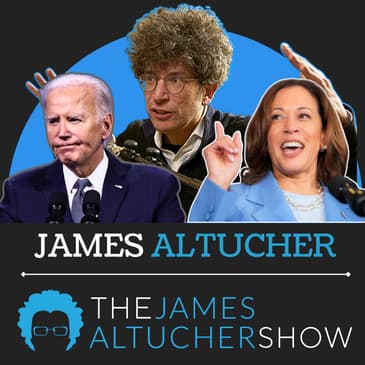



A Note from James:
"So, you know, just like last week, I wanted to bring a somewhat neutral point of view to all the wild conspiracy theories, allegations, rumors, and actual facts about the Trump assassination attempt. I wanted to comment on the conspiracy theories. What are the facts? What could be our open questions? And just state the truth about what's going on without any BS political bias. The reason there's bias is that right from the beginning, we have an election coming up. Democrats want to win. Republicans want to win. They hate each other. And so, they keep throwing these weird accusations at each other. Some of which may be true, most of which are not.
So now, we have Biden basically dropping out of the race. Kamala taking his place. What's being said? What is this being compared to? What has happened in the past? What are the conspiracies, and what's true and what's not? Someone actually wrote to me and said they were quite upset. I was taking a neutral point of view. I won't say what party this person was from. He thought I should not be neutral. My whole point is not necessarily that I have no feelings about any of these issues. I actually have quite a lot of feelings about the issues. But I am disgusted with how easy it is to see the bias in the headlines, in the accusations, whether it was CNN headlines, MSNBC headlines, or Fox headlines. You could just see how gross the bias was and how just lacking in morals and ethics and even business model the mainstream media has. I just wanted to bring some truth to the discussion.
So let's get right into it."
Episode Description:
In this episode of "The James Altucher Show," James tackles the contentious and dramatic events surrounding the 2024 election. With Biden dropping out and Kamala Harris stepping in, the political landscape is charged with conspiracy theories and partisan biases. James navigates through the noise to present a factual and neutral perspective on the Trump assassination attempt, the Democratic power struggles, and the unprecedented political maneuvers. Listeners will gain insights into the historical parallels, the behind-the-scenes power plays, and what these developments mean for the future of American politics.
What You’ll Learn:
- The factual background of the Trump assassination attempt and its impact on the political climate.
- Analysis of Biden's decision to drop out and Kamala Harris's rise to the candidacy.
- Historical precedents that compare to the current political situation.
- The internal power struggles within the Democratic Party.
- The potential impact of third-party candidates like RFK Jr. on the 2024 election.
Chapters:
- 00:01:30 – Introduction to the Trump Assassination Attempt
- 00:03:24 – Biden's Decline and the 2024 Debate
- 00:05:43 – Democratic Party Power Struggles
- 00:07:01 – Impeachment and Political Bias
- 00:16:22 – Historical Precedents and Political Uncertainty
- 00:31:43 – RFK Jr. and Third-Party Candidates
- 00:37:46 – Predictions and Final Thoughts
Additional Resources:
- Hunter S. Thompson - Fear and Loathing on the Campaign Trail '72
- Grover Cleveland - 22nd and 24th President of the United States
- Robert Cialdini - Influence: The Psychology of Persuasion
------------
- What do YOU think of the show? Head to JamesAltucherShow.com/listeners and fill out a short survey that will help us better tailor the podcast to our audience!
- Are you interested in getting direct answers from James about your question on a podcast? Go to JamesAltucherShow.com/AskAltucher and send in your questions to be answered on the air!
------------
- Visit Notepd.com to read our idea lists & sign up to create your own!
- My new book, Skip the Line, is out! Make sure you get a copy wherever books are sold!
- Join the You Should Run for President 2.0 Facebook Group, where we discuss why you should run for President.
- I write about all my podcasts! Check out the full post and learn what I learned at jamesaltuchershow.com
------------
Thank you so much for listening! If you like this episode, please rate, review, and subscribe to “The James Altucher Show” wherever you get your podcasts:
Follow me on social media:
[00:00:00] This isn't your average business podcast and he's not your average host. This is the James Altucher Show. So just like last week, I wanted to kind of bring a somewhat neutral point of view to
[00:00:25] all the wild conspiracy theories and allegations and rumors and actual facts to the Trump assassination attempt. I wanted to kind of comment on the conspiracy theories, what are the facts? What could be our open questions and just kind of state the truth about what's going on without
[00:00:45] any BS political bias? The reason there's bias is because right from the beginning we have an election coming up, Democrats want to win, Republicans want to win, they hate each other and so they keep throwing these weird accusations at each other, some of which may be true, most
[00:01:00] of which is not. And so now we have Biden basically dropping out of the race, Kamala taking his place. What's being said? What is this being compared to? What has happened in the past and what are the conspiracies and what's true and what's not?
[00:01:19] And again, somebody wrote to me actually and said they were quite upset I was taking a neutral point of view. I won't say what party this person was from. He thought I should not be neutral.
[00:01:30] And my whole point is not necessarily that I have no feelings about any of these issues. I actually have quite a lot of feelings about the issues, but just that I am disgusted with, as I mentioned in the podcast on the Trump assassination attempt, I am disgusted about
[00:01:47] how easy it is to see the bias in the headlines, in the accusations, whether it was CNN headlines, MSNBC headlines or Fox headlines, you could just see how gross the bias was and how just lacking in morals and ethics and even business model, the mainstream media has.
[00:02:07] And I just wanted to bring some truth to the discussion. So let's get right into it. Biden, since the debate, everyone clearly saw that the Biden of 2024 was not the same as
[00:02:17] the Biden of 2020, who by the way was not the same as the Biden of 2016 or the Biden of 2008 or 1988, for that matter. When in 1988, if you recall, Biden was running for president. He dropped out of the race because he was accused of plagiarism or his speechwriters were
[00:02:35] accused of plagiarism, but Biden didn't somehow manage the situation correctly. I'm not blaming him for anything. It's just that is why he dropped out in 1988. In any case, 2024, we see the debate with Trump. It was not good.
[00:02:49] And so the first kind of thing out there was that, why was this debate happening before the conventions? As far as I know, there was never a one-on-one presidential debate before the conventions. And again, I would highly encourage everybody to go on YouTube, Google or search for the
[00:03:08] 1960 presidential debates between John F. Kennedy and Richard Nixon. The two guys were polite to each other. They discussed issues. Some of the answers were five minutes long talking about boring agricultural issues, and they thanked each other and you're welcomed each other.
[00:03:26] And in general, it was a very different kind of debate than we have now. I did actually like watching this debate because they were shutting off the mics of everybody so there were no interruptions. And I felt both candidates behaved better than I thought they were.
[00:03:40] Of course, it was pretty clear Biden was having some issues, particularly if you watch side by side the debates from 2020 and the debates from 2024. And by the way, even watch in 2008, the debate between Biden and Sarah Palin.
[00:03:55] And you could see the difference between Biden now and Biden in times long gone. So a lot of people were saying maybe the Democrats engineered to have this debate before the convention as kind of a test run to see if maybe they should pull Biden
[00:04:12] from the race or maybe this was even, maybe they knew Biden was somewhat mentally deficient or not as sharp as he once was. And they wanted this to showcase that so they had an excuse to pull Biden off the ticket before the conventions and who might they be?
[00:04:31] Well, you can argue there's several just like in the Republican Party and the Democratic Party, there are several power groups. One is the Obamas Barack Obama and Michelle Obama. The other is the Clintons Bill Clinton and Hillary Clinton.
[00:04:46] The other is Nancy Pelosi, who as the most recent Democratic Speaker of the House was at one point the top ranking Democratic official in the government. And there's other theories about who's running the Democratic Party, but those are the main ones. And so maybe it was their plan.
[00:05:01] And of course everybody's got their agenda. The Clintons won the offhand chance Hillary Clinton might be a candidate again. The Obamas maybe were thinking Michelle Obama could be a candidate. I doubt they were really thinking that.
[00:05:14] I don't think Michelle Obama was thinking that, but that's what the theory is. Nancy Pelosi who immediately after the debate was calling for an open convention and maybe Nancy Pelosi was hoping for Gavin Newsom. Why would she be hoping for Gavin Newsom?
[00:05:26] Well, many people don't realize Gavin Newsom actually is her nephew. They are close relatives. So why not have your nephew be president of the United States? So everybody had an agenda. Everybody had a reason. Maybe even Kamala was hoping that Joe would be pulled from the race.
[00:05:43] Kamala Harris. So in any case, let's just address the first question. We did the Democrats not know Biden was mentally not as strong. And this is an important question because right now, in fact, today, as I speak,
[00:05:58] there was a Republican congressman I think from Texas has filed impeachment charges in the House to impeach Kamala saying the constitutional reasons for impeachment would be if she knew that the president of the United States was not capable of performing his duties to his fullest function,
[00:06:16] then she should have informed Congress and that's constitutional amendment 25. And hence, she should be impeached for not following the Constitution on such an important issue. Now I think that is ridiculous. I do think everybody knew.
[00:06:30] Not only do I think everybody in power knew that Biden was not as sharp. And by the way, people like John Stuart are saying this as well. It's not like I'm being political here. But not only did everyone know, but we all knew. Everybody in the country knew.
[00:06:45] I remember having this conversation in 2020, somebody who called me saying, you know, hey, we can't say X, Y, and Z. That's about Trump because we want Biden to win. He again didn't know what I was or if I was neutral or whatever.
[00:07:00] And I said, are you a little concerned about Biden's mental capabilities? And he said, no, everybody knows Biden is not as sharp, but he's got a strong bench and we do not want Trump to win. That's what this person who was fairly well known told me.
[00:07:16] And so it's not like this was a big secret that Biden was on the decline. So I think we've got to stop with the Democrats trying to impeach the Republicans and the Republicans trying to impeach the Democrats. This is ridiculous.
[00:07:31] Remember, even in August night, 1974, Richard Nixon was the first president to resign office. He resigned in order to avoid being impeached. It was clear he was going to be impeached. By the way, he wouldn't have been the first president to be impeached though.
[00:07:46] Andrew Johnson was impeached by the House of Representatives in the, I think it was around 1867. He was the president who took over after Lincoln was shot. He was Lincoln's vice president. Andrew Johnson was impeached. Clinton, of course, was impeached.
[00:08:01] And in both cases, the House impeaches you, which means it brings charges to the Senate, which judges you and the Senate in both cases throughout the case. So these were presidents who were impeached, but were not thrown out of office.
[00:08:14] If the Senate judges you, they could throw you out of office. But in both cases, it was just the House impeached and the Senate did nothing. But Richard Nixon did not want to be impeached. He resigned. And then his vice president Gerald Ford pardoned him.
[00:08:28] And what Gerald Ford said, of course, there were conspiracy theories. Richard Nixon had appointed Gerald Ford vice president only a few months earlier when Richard Nixon's vice president, Spiro Agnew, a name you don't often hear in history,
[00:08:40] Spiro Agnew resigned because he was being accused of, I think, accepting bribes. And he pleaded no contest in court. Anyway, Spiro Agnew resigned. Gerald Ford was appointed vice president and people thought Gerald Ford made a deal like, hey, appoint me to be vice president and I'll pardon you.
[00:08:57] I don't know whether or not that's true. I think it's probably half true without being directly stated. I think maybe Gerald Ford implied that he was inclined to think Nixon should be pardoned. Anyway, Gerald Ford pardoned Nixon.
[00:09:11] But what he said rings true, which is that let's move past this national trauma. And if there's a trial for Richard Nixon, it's just going to be the only thing in the news. It's going to get in the way of running the country.
[00:09:24] It's going to show America as weak and divided. And let's just move past this. And because he pardoned Richard Nixon, and because people thought there was some sort of deal, that's probably the reason Ford, an incumbent president, narrowly lost the 1976 election to Jimmy Carter.
[00:09:42] I do not think he would have lost that election to Jimmy Carter if he had not pardoned Nixon. But I think it's a profile encourage, actually, to use John F. Kennedy's phrase. I think it's a profile encourage that Gerald Ford did that and moved on.
[00:09:56] And I think we as a country need to move past and be statesmen rather than just bickering enemies between the Republicans and Democrats. Whoever is in charge seems to impeach the other side now. It's just kind of stupid, and it's definitely the opposite of profiles and cards.
[00:10:15] Let's just... The fact that we cannot run this country without shouting, you lie during a state of the union speech, is what's causing countries like China to consider invading Taiwan, Russia invading Ukraine, all the stuff going on with Iran, Israel, and so on.
[00:10:33] And I'm not blaming any party. It's a country divided, and that causes foreign policy issues. So just from a practical point of view, this impeachment stuff should be not allowed unless it's very serious. In any case, did people know Biden was going to have problems?
[00:10:50] Of course they knew. Of course. Nobody kept this a secret. Nobody was hiding this. We all knew. It came up in almost every single... If you watch any of Joe Biden's press conferences with his press secretary, it came up in every
[00:11:02] single press conference, and this was like a known thing. And so that's why I think... I do think it's possible the Democrats gave permission for this debate before the convention because it was the last chance for them to haul Biden out of the race. So the debate happened.
[00:11:19] A lot of pressure was put on Biden. At first he said he would not drop out, then he said he would drop out. If a medical condition arose, then by the way, a day later he got COVID. Guess what? A medical condition arose.
[00:11:33] He was seen walking around without a mask after he announced he had COVID. I don't know if that means anything or if people finally realize that when you're outdoors it's very hard to transmit this disease with or without a mask.
[00:11:46] In any case, this is not about COVID or masks. Those podcasts are four years ago. Biden dropped out of the race after there was a lot of pressure because first random Democrats put on pressure, but then finally when you really saw the prediction
[00:11:59] market change was when Nancy Pelosi put pressure. Now interestingly, when Biden dropped out, he sent two messages. The first message said he was dropping out and he wishes everybody well. And he thanked Kamala Harris for her service. But he did not endorse Kamala Harris.
[00:12:16] Now, I think what happened was the Democrats realized, hey, the Biden for president bank account has almost $100 million in it. What are we going to do with that money? Well, guess what? Kamala Harris was also legally on the legal documents for that bank account.
[00:12:35] I'm simplifying it, but just to explain what happened. So I think suddenly they realized within minutes, hey, if we want to access this $100 million, we've got to make Kamala the new candidate. So a few hours after Joe Biden sent out a press release that he was no longer
[00:12:52] the candidate, he sent up made another statement saying he was supporting Kamala Harris. The only reason I'm a little suspicious there that there was alternative agenda, meaning the campaign money was because why did he delay? Why didn't he just announce it in his initial statement?
[00:13:05] So that is a fair enough conspiracy theory. Now, there's another conspiracy theory that Joe Biden is dead because at that time, he hadn't been seen and he only made a press release. He didn't do like, even like Richard Nixon made a television announcement when he was resigning.
[00:13:23] He didn't just sort of send a post-it note to the Washington Post saying he was resigning. But in this case, it's fair to say Biden had COVID and maybe he just, he was sick. Who knows? So I am suspicious though of the timing of the Kamala endorsement.
[00:13:40] Okay, that said, for a while it looked kind of interesting that maybe there'd be multiple candidates. Some of the possibilities mentioned were Andy Bashir from Kentucky, a personal favorite of mine since he made me a honorary colonel in the state of Kentucky.
[00:13:55] There was also Josh Shapiro, governor of Pennsylvania. There was Gavin Newsom, of course, from California and they were at Governor of Michigan. So there were some possibilities, but that quickly ended when Biden and everybody else endorsed Kamala.
[00:14:08] The reason why all the Democratic chairs suddenly endorsed Kamala is because again, there's a hundred million dollars in cash sitting in that account. Once there's someone in charge of that account, it can also be used to support local elections.
[00:14:21] And I think a lot of Democrats are hoping to get a piece of that pie in their local election since there are many of them are having problems right now in the race because of the popularity of Trump.
[00:14:31] As I speak, even on Polymarket, the biggest prediction market, there's over 300 million dollars bet on the question of who will win the presidency. Donald Trump has 62 percent. Kamala, last I looked at about 34 percent chance and that's not a poll, by the way, in the polls, they're roughly equal.
[00:14:49] But in terms of who's going to win, it's percentage chances. To win a dollar, you have to bet 62 cents on Trump and you have to bet 34 cents on Kamala. And there's a few pennies for RFK, but nobody thinks he has any real chance.
[00:15:05] We'll get to RFK in a second. Take a quick break. If you like this episode, I really, really appreciate it. It means so much to me. Please share it with your friends and subscribe to the podcast.
[00:15:19] Email me at Altature at gmail.com and tell me why you subscribed. Thanks. First off, is there precedent for this? Has a national candidate ever been removed from a ticket after they were already not necessarily nominated, but after they had secured the nomination?
[00:15:46] Don't forget Biden has not yet been nominated, but he did secure the nomination. He had 99 percent of the delegates, something like that. So he was going to get the nomination. And also there's some question, can legally the delegates change their vote? I'll answer that one first.
[00:16:00] So yes, the delegates can vote for whoever they want. So what happens is in a primary, just like in a presidential election, you don't actually vote for a president. You vote for electors who represent your state and the electors meet in the
[00:16:14] electoral college and then vote for president. We don't have a pure democracy. As you know, we have a republic and it's because of this electoral college. Party nominations occur the same way. You vote for delegates who then go to a convention, the Democrat convention or Republican convention,
[00:16:28] the delegates vote for the president and the delegates, just like the electors, the delegates don't have to vote for who they were elected to vote for, but they traditionally do. Sometimes it has happened that there are open conventions where they can vote for whoever they want it.
[00:16:44] And interestingly, Nancy Pelosi, when she was calling for Biden to resign, she was calling for an open convention based on what the delegates have seen, let the delegates decide. And I believe she was calling for an open convention not only to convince
[00:16:58] Biden to drop out, but also to let it be known she wasn't endorsing Kamala Harris because she wanted Gavin Newsom. Now, she has, of course, since endorsed Kamala Harris. And yes, the delegates could vote for whoever they want. They are not obligated to vote for Joe Biden.
[00:17:13] There is an issue of who will make it to the state ballots now that Biden's dropping out. But I think the only issue is as far as I know, just invert very technically is that Kamala Harris has to decide who her running mate will be by August
[00:17:29] 15th because that is the deadline for Ohio's ballot. And that's the first real hard deadline. So we will see a vice presidential candidate for Kamala before August 15th. So now, has there ever been a situation like this before? So I keep seeing it in the news.
[00:17:47] People are bringing up LBJ in 1968 and Harry Truman in 1952. So LBJ, of course, Lyndon Maines Johnson became president when John F. Kennedy was assassinated in 1963. He won a huge reelection in 1964 against Barry Goldwater. And in 1968, he was kind of unpopular.
[00:18:09] There were Vietnam War, there were tons of protests at universities everywhere. And the Vietnam War was going to be a real political issue. And Richard Nixon, by the way, was promising to get us out of the Vietnam War. And LBJ was going into the primaries against Eugene McCarthy,
[00:18:26] who was very much against the Vietnam War, again, against an incumbent president. Very unusual that an incumbent president would get less than 90% of the vote in a primary. I mean, I think the incumbent president crushed it in all the primaries easily in this thing.
[00:18:43] That's typical for an incumbent. It's very rare that there are any challengers for an incumbent. But McCarthy was like a legit challenger. So Johnson dropped out and a few days later, four days after the New Hampshire primary,
[00:18:56] Robert F. Kennedy, the father of, of course, RFK Jr., announced he was running. And in just a few months, starting from scratch, RFK was the clear winner. He had clinched the Democratic nomination in June of 1968 after he won the California primary.
[00:19:14] And that day at the celebration party for the California primary, Robert F. Kennedy was shot and killed. Hubert Humphrey, who was LBJ's vice president, became the Democratic nominee. And Richard Nixon pretty easily defeated him and became the president of the United States.
[00:19:31] So, but I don't consider this Joe Biden thing. I don't think LBJ was a precedent for that. LBJ did not win the votes to become the Democratic nominee in 1968. He was probably going to lose. And that's why he dropped out.
[00:19:48] Whereas Joe Biden got 14 and a half million votes and won the Democratic nomination. He was going to be the Democratic nominee, so it's not a precedent. Similarly, Truman dropped out before the primaries. He didn't even run. Adlai Stevenson ended up running and Dwight Eisenhower crushed Stevenson.
[00:20:05] By the way, that was in 1952. In 1956, Eisenhower versus Stevenson was a rematch, disposed of the same Republican candidate and the same Democratic candidate, and the same result, Eisenhower defeated Stevenson. Rematches seldom occur in politics. This is going to be interesting for a reason.
[00:20:24] By the way, this was going to be a rematch, Trump versus Biden. Now it won't be a rematch. It'll be Trump versus probably Kamala Harris. And so in any case, Lyndon Baines Johnson and Harry Truman are not precedents to the current situation.
[00:20:39] The current situation is interesting to me because it speaks to a lot of uncertainty. What happens when, after a large number of voters commit to a candidate or a ticket, what happens when that ticket changes after the voters have voted and when there's uncertainty?
[00:20:56] And there's only one precedent, not precedent. There's only one precedent I could think of, which is 1972. George McGovern, this is Richard Nixon running for his second term, who was already an unpopular candidate. Watergate had already happened, and Richard Nixon was two years from resigning,
[00:21:15] but he was being investigated. McGovern was running, became a great book on this by the famous writer Humtor S. Thompson, is fear and loathing on the campaign trail in 1972. Magnificent book. Anyway, McGovern won the nomination. He picked Senator Thomas Eagleton, a senator from Missouri,
[00:21:33] to be his vice presidential candidate. And then Thomas Eagleton had some issues. He had announced and it was being reported that he had gotten electric shock therapy for depression. And now people didn't really understand issues like depression then as much as they do now, and electric shock therapy.
[00:21:51] I still don't even really know what that was for depression back in 1972. It's very different now. McGovern said he was going to stand by Eagleton. And then the next thing you knew, he wasn't standing by Eagleton and Eagleton dropped out of the race.
[00:22:06] He had already been nominated by the Democrats to be the vice presidential candidate. And then he dropped out of the race. George McGovern picked a new vice presidential candidate, Sergeant Shriver. He wasn't a sergeant in the army. That was his name, Sergeant Shriver.
[00:22:20] And he is the son of Eunice Shriver, who is the sister of John F. Kennedy, Robert F. Kennedy. Sergeant Shriver was a cousin to RFK Jr. In any case, it was Nixon Agnew versus McGovern Shriver. Not necessarily a popular candidate. Nixon won 49 states to one.
[00:22:41] The only state that George McGovern carried, he didn't even carry his own state, which was South Dakota. He carried Massachusetts, which is known as the most liberal state in the US. It's one of the few states or maybe the only state that Walter Mondale carried in 1984.
[00:22:55] Any case, McGovern was destroyed. Was he destroyed because of the uncertainty in the ticket? That happened, I think that was a big part of the reason. I mean, he would have lost anyway, but maybe he wouldn't have lost by as much.
[00:23:08] For instance, he probably would have carried Missouri and maybe other southern states, which was the reason Thomas Eagleton was put on the ticket. But he definitely did not carry those states after Thomas Eagleton was basically kicked off the ticket.
[00:23:20] And again, Eagleton voluntarily dropped out, but McGovern sort of seesawed on whether or not he stood by Eagleton. And I think that kind of uncertainty is happening now with the Democrats, which is why they're very eagerly coming behind Kamala to kind of insist that they're a unified party
[00:23:39] and that they're very excited about going forward, which perhaps they are. But I think that is the closest president is that they don't want to see this uncertainty create another blowout like Nixon versus McGovern. Now, are they really thinking about the 1972 election, election from 52 years ago? Maybe not.
[00:23:56] It's just the first thing that I think about when all these different, you know, they're saying LBJ and Truman instead, I don't think that's a fair comparison. There's actually another interesting comparison I want to bring up, which I'm certain nobody is thinking about,
[00:24:10] but it's worth mentioning because I think it'll probably mention more as the race continues or maybe yes, maybe not. But it's the 1892 election. And you're like, what? What does the 1892?
[00:24:22] I could see the shock on Jay's face as I say this because he didn't even know the U.S. existed in 1892. Why would the 1892 election have anything to do with the 2024 election? And the answer is it's the only time there's ever been in U.S. history
[00:24:42] a president who ended up serving two terms. They were not consecutive terms. So for instance, Ronald Reagan served two consecutive terms, 1980 and 1984. Barack Obama served two consecutive terms. 2008 and 2012 he was elected.
[00:25:00] Some presidents don't get elected like George H.W. Bush and, oh no, W, I was about to say W, but W served two consecutive terms. Clinton served two consecutive terms. Usually incumbents serve two consecutive terms. Jimmy Carter did not. George H.W. Bush did not.
[00:25:15] Let's see, Harry Truman did not. Well, he sort of did because he was president after Roosevelt died and then he got elected. But Herbert Hoover did not. Herbert Hoover was elected in 1928 and lost to Roosevelt in 1932. So in any case, Grover Cleveland was elected president in 1884.
[00:25:35] And then in 1888 after serving one term, Benjamin Harrison, the grandson of President William Henry Harrison, who was elected in 1840, Benjamin Harrison defeated Grover Cleveland. And in 1892, Grover Cleveland had a rematch. It was Cleveland versus Benjamin Harrison. And guess what?
[00:26:00] Grover Cleveland won and he became the first and only president to serve two terms that were not consecutive terms. And what's happening right now is Trump, if he wins, will be the next Grover Cleveland. Someone asked me the other day, was Grover Cleveland pro-crypto the way Trump is?
[00:26:19] Now, of course, that was a joke because obviously, crypto did not exist in 1892. But Grover Cleveland was the closest thing to a pro-crypto candidate because the reason he was running is a lot of people wanted inflation.
[00:26:35] Often, people in poor or distressed areas, they want inflation because they want... Let's say you're a farmer. You want the produce you grow on your farm to be bought for higher and higher prices.
[00:26:49] You want inflation, and that's how you build wealth is when you're able to make the produce for a low price and then there's inflation and you're able to sell the produce for a high price. So farmers and people in rural areas wanted inflation.
[00:27:04] Grover Cleveland was very, very much against inflation. And so a big political issue at the time is, is the US dollar held to a gold standard or a gold plus silver standard?
[00:27:17] And if you do a gold plus silver standard, that means you could have a lot more currency. You could basically print more dollars if I'm simplifying and saying this in 1892 terms because there's more gold plus silver in the world as opposed to just gold.
[00:27:33] And the US has a lot of silver as well as gold. So you could just make more currency. If your currency is backed by both gold and silver, you can print more dollars to represent the gold and the silver. And I'm using 1892 terms.
[00:27:47] If you're a hard money candidate and only want to have the gold standard, it's less inflationary because you can't print more money. Just like Bitcoin, Grover Cleveland wanted there to be a fixed amount of dollars. Bitcoin, a fixed amount of tokens, 21 million tokens in total can be printed
[00:28:05] and it were made in Bitcoin's future history. And Grover Cleveland was against printing more dollars by adding a silver standard. Now, interestingly, he picked a vice presidential candidate who was pro-silver. So that's how he balanced the ticket in 1892 so we could win over some Benjamin Harrison advocates.
[00:28:27] By the way, a lot of people in Harris' party didn't like it either. So it was one of the few times that an incumbent had a difficult primary season, you could say. And he won. So he became the incumbent.
[00:28:39] Benjamin Harrison became the Republican candidate and Grover Cleveland easily became a Democratic candidate. And he picked a pro-silver VP to balance the ticket. He won the election and became President of the United States again in 1892.
[00:28:56] Again, Trump will be the first person since Cleveland if he wins this election. So I think that actually and McGovern was a good president. By the way, one more precedent to this race is the 1912 election. Theodore Roosevelt became president after William McKinley died in 1901
[00:29:19] and Theodore Roosevelt became president then he was reelected in 1904. Everybody wanted him to run again in 1908. He was tired. He picked his good buddy William Howard Taft to run. He was disappointed in Taft and in 1912, he decided to form his own political party,
[00:29:36] the progressive party and run in 1912. Was Taft, Theodore Roosevelt and the former governor of New Jersey, Woodrow Wilson, who was running for the Democratic Party. Here's what happened. Woodrow Wilson only got 41% of the vote. He didn't get enough of the popular vote to go over 50%.
[00:29:55] That's because Taft and Roosevelt split the Republican vote. And so this is related to now because of RFK Jr. So we'll discuss that in a second. But the other interesting thing is while he was campaigning for president, Theodore Roosevelt was shot by an attempted assassin.
[00:30:11] The shot did not pierce through to his lungs and he was able to actually continue his speech and it became a hero. And there was a lot of adulation for him, but it was not enough to win the presidency.
[00:30:23] But that was mostly because the Republicans split the vote in half and Woodrow Wilson with less than 50% of the vote became the president of the United States for two terms. And by the way, that became a precedent because Woodrow Wilson was incapacitated from a stroke
[00:30:39] that no one knew about for the last 18 months of his presidency and his wife was running the country. So hence the failure of one of his biggest initiatives, the League of Nations. That's another story. Let's get to can the vote get split?
[00:31:09] We have a third party, Robert F. Kennedy Jr., who has been on this podcast. Robert F. Kennedy Jr. is running for president and he has a lot of Democrat issues like on the environment but he also has a lot of Republican issues like his issues on vaccines.
[00:31:27] And I would say he's extreme on both ends. Like, despite him claiming to me personally that he was not anti-vax, he is very anti-vax and I don't mean anti-COVID-vax. He is anti every vaccine. So polio vaccine, all these things.
[00:31:43] Now he might say he's not but I think he is and there's a lot of evidence for that. So I will just say allegedly he's anti-vax. He also comes from Democrat royalty. His father, as I mentioned, was Robert F. Kennedy.
[00:31:56] He was about to win the 1960 nomination and would certainly have crushed Nixon in the election. And his uncle, John F. Kennedy, was president of the United States. His other uncle, Ted Kennedy, was senator for about 50 years and ran for president many times including against an incumbent Jimmy Carter.
[00:32:14] Many of our RFK Jr.'s cousins have been governors, congressmen. We're going to have on a Kennedy in the next few weeks. You'll find out who soon. In any case, RFK Jr. is very solid Democrat credentials
[00:32:28] and he initially was running as a Democrat but then he switched to independent and he's got Republican credentials because the Republicans love him because of the vax stuff or some Republicans do. In fact, it was rumored Trump even offered the vice presidency to RFK Jr.
[00:32:44] I don't think that's true actually because given the pick of JD Vance, it seems to me Trump is not trying to balance the ticket. He just wants to avoid a Mike Pence. Mike Pence balanced the ticket in 2016 for Trump
[00:32:58] but that turned out to be useless for Trump in 2020. And when I say balanced, Mike Pence was a traditional Republican well connected in the Republican machine. Trump, a former Democrat, was not a traditional Republican so he wanted to balance that way.
[00:33:13] But now Trump could care less about balancing it. He wants somebody who will play the other role that a vice presidential candidate typically plays, which is a tack dog. Typically in election, you stay presidential and you let your vice presidential candidate
[00:33:29] be the one who does the vicious attacking of the other candidates. A good example might be McCain-Sarapallan. So in any case, I don't think Trump offered RFK Jr. the vice presidency but there were even rumors that RFK Jr. was going to give a speech
[00:33:43] at the Republican National Convention. So that's how closely tied he is to the Republican Party as well as the Democratic Party. But now you look at the polls. What are the polls say? Is RFK Jr. going to take more votes from the Democrats or from the Republicans?
[00:33:57] This is the critical issue because even though RFK Jr. is only getting about three or 4% in the polls, remember these have been close races. 2016 was close, 2020 was so close. So close that both elections were contested in the courts.
[00:34:13] So three or 4%, he's obviously not going to win the presidency but he could draw enough votes from one of the candidates to disturb, you know, to change the result. So just like in 2000, you know, Bush Gore was very close.
[00:34:29] It came down to like something like 100 votes in Florida and everybody was upset at the third party candidate, Ralph Nader who got almost no votes but he did get more than a couple hundred votes in Florida. Probably those were all votes that were going to go to Gore
[00:34:44] otherwise and Gore lost the entire national election. So everybody's been upset at Ralph Nader. Everybody on the Democratic party's been upset at Ralph Nader ever since. So will RFK Jr. have enough votes to change the way this goes?
[00:34:57] And if you look at the polls, the first answer is no. He seems to be drawing about 40% from the Democrats and 40% from the Republicans with, I guess, 20 random percent. This could come down to state by state so we don't know, but on the surface,
[00:35:11] it seems like RFK Jr. will not change in any way, shape or form the results of this election. By the way, another third party candidate who did change the results of an election was Ross Perot who was running in 1992.
[00:35:25] And I forget what percent of the votes he got but he got enough votes that he was drawing votes from Bush and Clinton won and probably Clinton won in large part because Perot took many Republican votes. You can argue in 1980, a liberal Republican
[00:35:41] by the name of John Anderson was running as a third party candidate. I think it was the American Independence Party. And it was Ronald Reagan, Jimmy Carter and then distant third, John B. Anderson. And he was liberal, but I don't know
[00:35:54] if he drew enough votes from the Democrat side to really say that's the reason Carter lost. I think Reagan was destined to win that. Reagan won by a lot. So in any case, I don't think RFK Jr. is gonna have an effect. I'm just trying to think,
[00:36:08] are there any other conspiracy theories I am ignoring here? Joe Biden is not dead. I do think the reason the party is uniting so quickly behind Kamala as opposed to having an open convention is several reasons. One is the cash, the sheer cash
[00:36:23] that was waiting for her if she was the nominee. And it wasn't necessarily waiting for other candidates. By the way, Trump's legal team is contesting that Kamala has access to that cash but they're going to lose probably. Kamala's name was on the legal documents
[00:36:40] forming Joe Biden's presidential campaign committee. And so she's on that, but no other candidate was. So I think that's again, the reason why they unified so quickly behind her. And I also think they want to avoid uncertainty. And I don't necessarily think they're directly thinking of McGovern Eagleton
[00:36:58] and McGovern Shriver, but uncertainty is bad for an election. And that's the only precedent I could think of where there was such uncertainty at the national level. And other than that, who's going to win? Well, again, I said the Polymarket odds are about,
[00:37:15] let's just see if they've changed in the past few hours. Since I started talking, I feel like I talked for hours on this stuff. Polymarket.com, which party will win? Donald Trump has 63%, Kamala Harris has 33%, Michelle Obama interestingly has 3%, Robert F. Kennedy Jr. has 1%.
[00:37:33] Hillary Clinton has less than 1%. Joe Biden, once the Democratic nominee has now less than 1% chance, according to Polymarket, of winning the presidential election of 2024. Here's what I predict will happen, is that you're going to see from August 19th to August 22nd is the Democratic National Convention.
[00:37:52] There will be, just like there was after the Republican convention, there will be a lot of excitement, primetime, Kamala Harris give a speech, her vice presidential candidate give a speech, probably Barack Obama will give a speech, and other, probably Joe Biden will give a speech.
[00:38:07] So there's going to be a lot of excitement around the Democratic Party. And typically in the days after a convention, that party has a spike in popularity. So I do expect these odds to change. Let's say worst case, Kamala will probably pop to 40% chance.
[00:38:24] Best case, maybe she might go up to 50% chance on the odds. By the way, the odds have nothing to do with who wins. Still a good 90 days away from the election in November. So a lot of things could play themselves out, and we'll see.
[00:38:37] But if I was a betting person, I would assume that Kamala is going to pop in the odds during the convention again, that's between August 19th and August 22nd. One thing I will mention, I was talking with both Robert Shildini and Scott Adams about the 2016 election.
[00:38:55] And this was literally eight years ago. I was having these conversations. Robert Shildini of course is the author of the book Influence. And Scott Adams is famous for predicting that Trump will be president as early as a year and a half before the election,
[00:39:09] when there was still something like 18 other Republican candidates. Scott Adams said, nope, it's going to be Trump winning the whole thing. And both Adams and Shildini, and Shildini believe he was Hillary Clinton's advisor on some of her ways of persuading people. Not the whole time.
[00:39:25] So I don't think he deserves any blame for what happened in 2016. But I was having a conversation with one of them and I believe it was Scott Adams. And Scott Adams was telling me that basically Hillary Clinton was spiking in the election,
[00:39:40] like she was winning in the polls in the summer of 2016. And her slogan then was, do you want Trump's hands on the red button on the nuclear buttons? And that was the way she was spiking in the polls because no one really knew
[00:39:55] what kind of crazy Trump really was. I mean, they're all crazy, I think. And nobody really knew, was it a good crazy, a bad crazy, whatever. So when she kept saying it over and over, do you want this guy's fingers on the button?
[00:40:09] She was spiking in the polls. But then she switched her slogan to, I'm with her. And from that point on, according to my conversation with Scott, Scott thought she really had a doomed race from that point on because not everybody's going to like that slogan
[00:40:24] to be honest, I'm with her. And I noticed that Kamala Harris is inheriting that same slogan. So for her sake, she probably wants to reconsider. I mean, make America great again is a slogan that Reagan used. And Reagan was a successful candidate.
[00:40:39] I'm with her as a slogan Hillary Clinton used and she was an unsuccessful candidate. So just in terms of the game of politics, look to the past for success and failure and pick your strategy accordingly. I would advise that to candidates on both sides. Meanwhile, stay tuned.
[00:40:57] I will provide other updates, particularly after the Democratic Convention on what is actually happening as opposed to what all the BS media is saying. And I hope you enjoyed this. If you enjoyed this, share it with your friends, subscribe to the podcast.
[00:41:12] It really helps me share, talk about it, say I learned something new about Grover Cleveland today, contest people when they say, oh, this is just like 1968, say no, it's like 1892. Maybe it's like 1912 and maybe it's like 1972, but it is definitely not like 1968
[00:41:30] and impress your friends at cocktail parties. And I'll see you soon.