
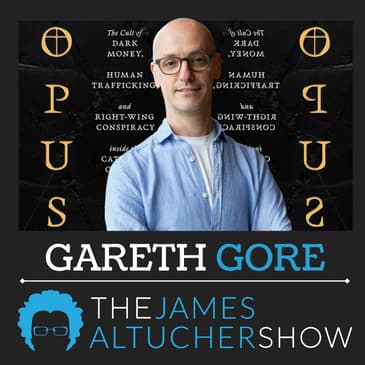



A Note from James:
Have you ever read The Da Vinci Code?
That book was definitely a page-turner. Before I read it, I had never really heard of Opus Dei. And after today’s conversation with Gareth Gore, you might wish you had never heard of Opus Dei either.
In The Da Vinci Code, Opus Dei is a mysterious organization tied to the Catholic Church, secret history, and global power. But today’s guest, Gareth Gore, started investigating Opus Dei from a completely different angle. He was looking into the 2017 collapse of a major Spanish bank. He found something much bigger: a secretive organization with connections to global finance, politics, elite schools, the FBI, and even the highest levels of power in Washington, D.C.
His book is Opus: The Cult of Dark Money, Human Trafficking, and Right-Wing Conspiracy inside the Catholic Church. And what he found is disturbing. Officially, Opus Dei promotes holiness in everyday life. And honestly, I like parts of that idea. But Gareth argues that behind the public message is a high-control organization built on secrecy, manipulation, financial opacity, and alleged abuse.
We talk about how Opus Dei recruits from both the ultra-wealthy and the desperately poor, the strange ownership structures tied to hundreds of millions of dollars, the Robert Hanssen spy scandal, alleged influence in Washington, and Gareth’s recent private meeting with Pope Leo, where he says he gave the Pope a dossier calling for serious action.
This is an eye-opening story. Here’s Gareth Gore.
Episode Description:
James talks with investigative journalist Gareth Gore about Opus Dei, the secretive Catholic organization at the center of Gareth’s book Opus. What started as Gareth’s investigation into the collapse of Banco Popular in Spain led him into a much larger story about money, power, religious authority, alleged exploitation, and the ways an institution can hide behind noble language while pursuing a much harder political and financial agenda.
Gareth explains that Opus Dei officially presents itself as a Catholic movement dedicated to helping ordinary people find holiness through daily work. But his argument is that the public message conceals a high-control system built around recruitment, secrecy, spiritual pressure, and influence inside elite institutions. He describes Opus Dei as both an official part of the Catholic Church and, in his view, an abusive cult. Opus Dei strongly disputes Gareth’s book, calling it a false picture based on distorted facts and conspiracy theories.
The conversation moves from Opus Dei’s founding in Spain in 1928 to its special status as a personal prelature, its alleged links to Banco Popular, its recruitment practices, the Robert Hanssen spy scandal, elite schools, Washington power networks, and Gareth’s recent meeting with Pope Leo. The episode is useful because it does not treat Opus Dei as just a conspiracy theory symbol from The Da Vinci Code. It asks a more direct question: what happens when a religious organization accumulates money, secrecy, political influence, and moral authority at the same time?
What You’ll Learn:
- What Opus Dei officially is, and why its status as a personal prelature matters.
- How Gareth Gore went from investigating a Spanish bank collapse to writing a book about Opus Dei.
- Why Gareth argues that Opus Dei’s public message differs sharply from its internal practices.
- How Banco Popular allegedly became a financial engine for Opus Dei-linked projects.
- Why Gareth compares aspects of Opus Dei to a high-control cult.
- What Gareth says happened in the Robert Hanssen spy scandal.
- Why the alleged recruitment of minors and underprivileged girls has become one of the most serious issues around the organization.
- What Gareth told Pope Leo in their private meeting.
Timestamped Chapters:
- [02:00] Gareth Gore on Opus Dei as an alleged abusive cult
- [02:41] Opus Dei as a “rising militia”
- [03:54] A Note from James: from The Da Vinci Code to Gareth’s investigation
- [05:54] Gareth joins the show
- [06:00] How James first heard of Opus Dei
- [06:37] Gareth’s background as a financial journalist
- [07:11] What is Opus Dei?
- [07:45] Opus Dei’s status as a personal prelature
- [08:40] Why that structure gives Opus Dei unusual freedom
- [09:15] Gareth’s argument: official Catholic structure, unofficial high-control group
- [10:03] The positive public message of “holiness in everyday life”
- [10:43] Josemaría Escrivá and Opus Dei’s founding
- [12:00] When Gareth thinks the movement turned political
- [13:30] Spain on the edge of civil war
- [14:14] Escrivá’s followers as a “secret army”
- [15:19] Why Opus Dei recruits from elites
- [16:00] Why Opus Dei also recruits from the poor
- [17:09] Underprivileged girls and alleged domestic servitude
- [17:37] How recruitment works by invitation
- [19:15] Lifelong study, confession, and spiritual guidance
- [19:54] Opus Dei’s modern agenda
- [20:46] Sex, family values, and political identity
- [22:05] Why Dan Brown chose Opus Dei for The Da Vinci Code
- [24:01] Banco Popular and the financial trail
- [25:54] The mysterious shareholder structure
- [26:34] Shell companies and alleged financial flows
- [27:15] Why not publicly identify Opus Dei as a major shareholder?
- [28:27] Arm’s-length foundations and deniability
- [29:52] Are there good people inside Opus Dei?
- [30:32] The founder’s rules and internal control
- [32:51] What happens when people leave
- [33:52] Robert Hanssen and Opus Dei
- [35:00] Hanssen’s wife, confession, and the Opus Dei priest
- [36:24] Gareth’s theory of institutional self-protection
- [40:03] How the bank collapse connects back to Opus Dei
- [41:00] Why Gareth thinks ownership structure delayed reform
- [42:43] Gareth’s private meeting with Pope Leo
- [44:26] The dossier Gareth gave the Pope
- [45:08] Why Gareth says the meeting went better than expected
- [46:15] Allegations involving minors and grooming
- [47:00] Opus Dei schools and elite recruitment
- [48:20] After-school clubs and hidden recruitment claims
- [49:16] Can the good message be separated from the organization?
- [50:44] Why Gareth thinks the founder’s rules are the central problem
- [51:51] The problem of Escrivá’s sainthood
- [53:00] Could the canonization process be reopened?
- [54:00] Opus Dei, Silicon Valley, and cult-like power structures
- [56:41] Peter Thiel, Stanford, and Opus Dei overlap
- [57:29] Closing thoughts on Opus
Additional Resources:
- Opus: The Cult of Dark Money, Human Trafficking, and Right-Wing Conspiracy inside the Catholic Church by Gareth Gore.
- Opus Dei’s official website.
- Opus Dei’s explanation of its status as a personal prelature.
- Opus Dei’s official response disputing Gareth Gore’s book.
See Privacy Policy at https://art19.com/privacy and California Privacy Notice at https://art19.com/privacy#do-not-sell-my-info.
[00:00:01] Today on The James Altucher Show. This is certainly what I argue in my book. It's also an abusive cult. This is a group that basically abuses ordinary Catholics' desire to kind of go deeper into their faith, to become more serious Catholics.
[00:00:17] It kind of latches onto that. And then it kind of takes advantage of things like confession and spiritual guidance sessions to get into the brains of people, to get into their lives, to collect information about them, and then to manipulate them to furthering its aims. And so officially it's this officially sanctioned wing of the Catholic Church, but unofficially it's an abusive cult that has drawn in many unsuspecting Catholics over the years.
[00:00:45] He started to describe his followers as a rising militia. He saw them as this kind of, this secret army that would kind of insert itself into society. In particular, into positions of power inside society. And he saw his followers as being, as kind of tasked with using their influence in those positions to fight back against this progressive agenda.
[00:01:10] But because this is an organization that's built on these hundreds and hundreds and hundreds of pages of rules, this kind of system of abuse and control and manipulation, all written by the founder.
[00:01:23] You know, at some stage that kind of takes over. It's a cult and, you know, bit by bit they're drawn in and they justify to themselves that what they're doing, even if they have some misgivings about what they're doing, you know, maybe I shouldn't be recruiting this 10 year old kid or whatever. You know, even if they're having misgivings, they tell themselves that this is what God wants.
[00:01:48] This isn't your average business podcast and he's not your average host. This is the James Altucher show. So have you ever read the Da Vinci Code? This was definitely a page turner book. I read it like, I don't know, sometime in the nineties.
[00:02:14] Before I read that book, I had never heard of Opus Dei. And after today's conversation that you're about to listen to, you might wish you had also never heard of Opus Dei. But in the Da Vinci Code, they were this secret, mysterious organization that was behind all the finances of the Catholic Church. And Tom Hanks played the main guy in the movie and he's battling against all the conspiracy theorists.
[00:02:42] But anyway, today's guest, Gareth Gore, he started digging into Opus Dei when he was investigating the 2017 collapse of a major Spanish bank and uncovered something far bigger. This secretive organization with tentacles reaching into global finance, politics, elite schools, the FBI, and even the highest levels of power in Washington, D.C. And what he found was a group that officially promotes holiness in everyday life.
[00:03:10] I actually like some of the principles that they were built on, but unofficially operates like a high control cult complete with grooming of minors, financial secrecy, and a playbook written by its founder that still followed to this day. So we talk about everything. We talk about how Opus Dei recruits from the ultra wealthy and the weird way they recruit from the desperately poor, the strange ownership structures that funded hundreds of millions of dollars through shell companies, the Robert Hansen spy scandal.
[00:03:39] I mean, this was the biggest spy in U.S. history was a member of Opus Dei and how Opus Dei covered it up, their influence on Supreme Court justices, and even Gareth's recent private meeting with Pope Leo where he hand over a dossier calling for serious action. So this is an eye-opening story. Here's Gareth Gore. How are you, James?
[00:04:09] Yeah, good. How are you? I'm good, thank you. Thank you for inviting me onto the show to chat about the book. Yeah, such an interesting topic. I mean, I don't want to get into the meat of it right here, but it's interesting for a variety of reasons. And I had never, you know, obviously before the Da Vinci Code, I had never even heard of Opus Dei. And then until your book, I never even thought about Opus Dei after that. You know, obviously the Da Vinci Code presents a very fictional, exotic kind of conspiracy happening, but you get more into the meat of what's actually happening.
[00:04:38] Yeah, I mean, you and me both, I hadn't really heard of Opus Dei before the Da Vinci Code either. And almost fell into this story completely by accident as well. So yeah, I'm happy to talk about all of that. Right, so you were a financial journalist. And by the way, I used to have a column with the Financial Times. I wrote for the Wall Street Journal. So I have similar kind of background in some sense. You were investigating the collapse of a Spanish bank that collapsed in 2017.
[00:05:06] And you uncovered that this kind of very secretive, mysterious organization, Opus Dei, was involved at every level of the bank and, you know, potentially contributed to the bank's collapse. But then upon further research, it was this basically worldwide organization. It almost reminds me of Scientology, the way you describe it. But maybe describe what is Opus Dei to begin with?
[00:05:32] Because I think it's like a weird sort of organization that structurally is hard to understand. Yeah, totally. I mean, so Opus Dei is, I guess, officially speaking, a kind of a part of the Catholic Church. It's this thing called the personal prelature. It kind of has this special status inside the Catholic Church. And it's had this special status since the early 80s. I'm sorry to interrupt, but when you say personal prelature, that means it's like not a geographic region.
[00:06:01] It's an organization, but it could have its own bishop. It used to have its own bishops. It's a bit more complicated than that. But basically being a personal prelature, yes, it's kind of, it's a worldwide diocese. It kind of operates outside of the normal hierarchy of the church. So what this special status does is allow Opus Dei to operate wherever it wants to in the world, wherever it's, you know, it thinks it might do work or it might kind of expand or wherever it might kind of, I guess, meet its own objectives.
[00:06:30] So it has this special status. What that does is mean that, you know, it's not answerable locally to the local archbishop. So if there's ever, you know, any cases of wrongdoing or the local bishop or archbishop is concerned about something that's happening, something that Opus Dei is doing, they have absolutely zero power to do anything about it. And, you know, that was a very useful thing for Pope John Paul II was the guy that gave them this special status.
[00:06:55] And for him, it was a very kind of useful thing because here was a group, you know, a group of like-minded conservatives just like himself. And he could basically post them wherever he wanted around the world. You know, if there was some bishop who was causing trouble, some progressive bishop in Norway or in Kenya or whatever, he could send these guys there and kind of do his work, keep an eye on the local archbishop. Opus Dei was like, you know, his green berets almost that he could send wherever.
[00:07:24] So yes, Opus Dei is part of the Catholic Church. But I would argue, and this is certainly what I argue in my book, it's also an abusive cult. This is a group that basically abuses ordinary Catholics' desire to kind of go deeper into their faith, to become more serious Catholics. It kind of latches onto that. And then it kind of takes advantage of things like confession and spiritual guidance sessions
[00:07:50] to get into the brains of people, to get into their lives, to collect information about them, and then to manipulate them into doing, you know, to furthering its aims. And so officially, it's this officially sanctioned wing of the Catholic Church. But unofficially, it's an abusive cult that has drawn in many unsuspecting Catholics over the years. Yeah, and this is the part we mentioned before, the way you describe it almost sounds a little like Scientology.
[00:08:17] But I want to back up on that just a second, because when I was just reading about it, basically in preparation for this podcast, they seem to have a good message, which is that, hey, if you're interested in being more religious and more spiritual, you don't need to be a priest. You don't need to live a monastic life. You could basically, you know, worship God through day-to-day efforts and meaningful work and labor and so on.
[00:08:46] Like that has a very positive message. And I guess that was developed by the founder, Jose Escriva, in 1928. Yeah, no, absolutely. I mean, they've got a great marketing department, and they always have done. He was the marketing department back in 1928 when the group was first founded. But yeah, absolutely. That's the message that they put out to the world. That's the way they draw people in. The message is that anyone can aspire to holiness. You know, in their daily lives, you don't need to become a priest or a monk or a nun
[00:09:14] in order to dedicate yourself to God. If you're a doctor or a teacher or if you're a housewife or if you're whatever you're doing in whatever aspect of your daily life, by simply giving your best and striving for perfection, that's a way of serving God and that's a way of attaining holiness. And so, yeah, absolutely. It's a very kind of laudable message, something that I also would agree with. I mean, it'd be very hard to pick any holes in that. But like I said before, I mean, that's just a front.
[00:09:44] You know, that's the kind of marketing material they use to hook you and to draw you in. What do you feel became a front? Did you feel the founder, who's now a saint, do you feel the founder didn't really believe this? Or like, at what point do you think it was just being... And why isn't it a front? Like, what did they really want to do? Did they really want to have like, they wanted to all get wealthy? Or like, what was their real goals as opposed to what their stated goals were? I mean, that's a really interesting question. And I'm not sure I'd really have the answer to that.
[00:10:13] I mean, I think... So, okay, let's kind of reverse. October 1928, this priest, this Spanish priest called José María Escribar, he went on retreat. And, you know, he'd kind of been struggling with his faith. He wasn't quite sure whether he definitely wanted to be a priest or not. He was considering kind of ditching your all and becoming a civil servant. But at the same time, he had these kind of airs of grandeur. Like, his mother from, you know, since he was a baby, basically told him that, you know, he'd been saved as a child
[00:10:42] and the Virgin Mary had saved him personally and wanted great things for him. So he kind of was carrying all of this pressure to be something. And I think he was kind of struggling. And whilst he was on this retreat, he had this vision. He later told people that it was a vision that came directly to him from God for this new type of Catholic movement, which would become Obus Dei. And initially, it was just as I've described. It was, he saw Obus Dei, which in Latin means the work of God,
[00:11:10] as a way for ordinary Catholics to go deeper into their faith. And that's how it started. I mean, for the first few years, he failed miserably. Like, he tried to recruit people and basically didn't manage to recruit a single person. And at the same time, there was huge events happening around him. This was Spain quite literally on the brink of civil war. The workers had risen up. You know, they'd turned their backs on the monarchy. They'd overthrown the monarchy, kicked them out. They were demanding new rights for themselves. And critical for our story, they were turning their backs
[00:11:39] on these traditional institutions like the church. The church, up until that point, had had a major role in almost every element of society, not least education, culture, and the rest of it. As people were beginning to question the establishment, you know, they're beginning to ask questions about the church, turning their backs on the church. Esqueribar, the priest, the founder of Upper's Day, saw what was happening around him, saw the way that the church's hold of society was kind of slowly being diluted. And he was horrified.
[00:12:09] At the same time, you know, it's important to emphasize, you know, not only were people questioning the church, but there were church burnings, you know, priests were being attacked in the streets. And so, you know, this quite, you know, benign, quite laudable idea started to evolve. He started to describe, and this is from his own writings, he started to describe his followers, and they were very, the very few in number at that point, as a rising militia.
[00:12:38] He saw them as this kind of, this secret army that would kind of insert itself into society, in particular, into positions of power inside society. And he saw his followers as being, as kind of tasked with using their influence in those positions to fight back against this progressive agenda. And so, you know, that was, for me, the turning point in the early 1930s, you know, just a few years into the movement,
[00:13:05] it started to take on this quite, you know, politicized hue. And that stayed ever since. And so, you know, ever since then, the group has always aspired to recruit from the elite of society because basically they are the people that can help it to push forward this kind of reactionary agenda. And you mentioned in the book, for instance, connections like Robert Hansen, the FBI agent who was spying for the KGP notoriously, but probably the biggest secret agent in US history
[00:13:35] was an Opus Dei member. And we could talk about that in a bit. And also, you imply several Supreme Court justices either have connections to Opus Dei or might even be Opus Dei members. And these are just a few of the kind of very powerful connections they have. But the question I have is, they also seem to be recruiting, and this is the whole Argentinian case you described, they also are recruiting from the impoverished and poor people. So it seems like this, why the two sort of sides?
[00:14:03] So, Opus Dei predominantly recruits from the elite. I think probably something like 90% of its membership is made up of these elite members who are people like politicians, business people, judges, journalists, anyone that can kind of influence and help to shape society. A subsection of Opus Dei members, the main recruiters are these celibate members of Opus Dei who live in Opus Dei residences all around the world.
[00:14:32] And I don't know which city you're joining me from, but it's almost certain that Opus Dei has a residence in the city where you are. There are quite literally hundreds of these around the world. And so, you know, in these kind of residences for the celibate members, you know, they live a very controlled existence. Every minute almost is controlled. And they're watched over. These are kind of closed off from the wider communities, these residences. And the founder kind of realized at some point
[00:15:01] that they needed a team of servants to basically run these residences, to cook and to clean or whatever. And that was the point where they decided that, you know, in addition to recruiting from the elites, we also need to target underprivileged girls. And they're all girls, you know, they don't recruit young boys or men to cook or clean. It's always, you know, these are women's jobs in the minds of Opus Dei. And so, yes, in addition to the elites, they also have this operation where they're recruiting underprivileged girls
[00:15:30] in parts of Latin America, parts of Africa and Asia, kind of promising them a better life. But basically, they're being recruited to be slaves for Opus Dei to cook and clean for the elite members. And when they recruit the elite, like, did the elite have to go through, you know, years and years of training and study the way a normal member of Opus Dei would have to go through? Or if I'm like a congressman in the US and I show up at the local Opus Dei and say, hey, I'd love to be a member,
[00:16:00] am I signed in right away? Well, first of all, you can't do that. Even if you're a congressperson, you can't just turn up at the local Opus Dei center and say, hey, I'm kind of interested in joining you guys. You can't go onto the Opus Dei website and request a brochure, be kind of mailed out to you about how to become a member. However, recruitment is by invitation only. So, you know, they basically decide who might be useful to the organization and they go after them and they target them. And so, you know, initially,
[00:16:29] you know, they'll kind of make connection with you and they'll come out and they'll meet you. They'll kind of invite you to perhaps to come along to one of the evenings of recollection or some events that they're hosting back at the center. And then, you know, you'll be invited to maybe confess to the Opus Dei priest. You'll be invited to participate in spiritual guidance sessions. You know, bit by bit, they're kind of working out whether you're kind of on the same wavelength,
[00:16:58] whether they can draw you in, how much, how useful you might be to the organization and whether they're, you know, going to be able to manipulate you in some way. You know, once they've ticked a series of boxes and, you know, in some places, it quite literally is a series of boxes that the recruiters are ticking off. Only then will you be asked whether you, you know, would consider becoming a member. You know, once you're a member, it's kind of a lifelong period of study and spiritual guidance. You're expected to attend weekly
[00:17:28] or biweekly sessions. You confess with Opus Dei priests very regularly. You know, one of these recruiters, these numeraries, these celibate members is kind of allocated to you as your personal spiritual guidance counselor. And, yeah, that's kind of when the real work begins. Take a quick break. If you like this episode, I'd really, really appreciate it. It means so much to me. Please share it with your friends and subscribe to the podcast. Email me at altitra at gmail.com
[00:17:57] and tell me why you subscribed. Thanks. Every business is asking the same question. I consult for a lot of different businesses and I can tell you this, every business, every entrepreneur is asking the same question. How do we make AI work for us? The possibilities right now are endless. It's impossible to even keep up with all the new innovations that are happening. But the one thing we know
[00:18:26] is that sitting on the sidelines is not an option because one thing is almost certain. Your competitors are already making their move. They're already using AI. So with NetSuite by Oracle, you can put AI to work today. NetSuite is the number one AI cloud ERP trusted by over 43,000 businesses. It's a unified suite that brings your financials, inventory, commerce, HR, and CRM into one single source of truth. That connected data is what makes the AI actually smart.
[00:18:56] It doesn't just guess. It knows. It intelligently automates routine tasks, delivers actionable insights, helps you cut costs, and make fast AI-powered decisions with total confidence and flexibility. This isn't some bolted-on AI tool. It's AI that's built into the system that runs your entire business, whether you're in software, healthcare, manufacturing, financial services, or really any industry. NetSuite delivers a customized solution. It works whether your company is doing millions of dollars in business or even hundreds of millions in revenues.
[00:19:25] It even works if you just have a podcast. You can have NetSuite look up your future guests, prepare, you know, summaries of books or whatever. I mean, I always like to read the books, but it's not so bad to have an AI assistant help me out whenever possible. So look, if I were scaling a business right now, this is exactly the system I'd be using. If your revenues are at least in the seven figures, get the free business guide, Demystifying AI at NetSuite.com slash James.
[00:19:55] The guide is free to you at NetSuite.com slash James. Again, it's NetSuite.com slash James. You know, obviously what got you into all of this is the scandal that we're going to discuss, but like, what is, you know, fast forwarding to the present day, what do you think is their agenda right now? Like, what are they recruiting for? What do they want for themselves?
[00:20:25] I think it's, it's slightly confused and also, you know, kind of quite vague. In general, they see themselves as part of the vanguard that's kind of fighting back, you know, against this kind of, all of, you know, progressive advances that we've seen in society. You know, things like the acceptance of same-sex marriage and homosexual relations is a way that kind of, you know, women have been liberated from the home and kind of want to aspire to have careers for themselves.
[00:20:54] They're kind of fighting against this. They're fighting for a more traditional kind of family values, kind of family life. And so, you know, I think that's the thing that really guides them. You know, whether they have a policy on the Iran war or on taxation is something, something different. But, you know, they're really kind of fighting for very traditional family values. This is a group that's absolutely obsessed with sex and sexuality and, you know, sin, carnal sins. And so,
[00:21:24] that's kind of one of the major things. And so, of course, abortion is a big issue, but also premarital sex and that kind of thing. Like, why do people care about what everyone else is doing in the whole world? Well, yes, I mean, I would certainly agree with that. But I think for them, it's kind of a signaling mechanism in a way. It's a, you know, harking back to traditional family values is, it's almost like a dog whistle kind of thing. You know, if you agree with these kinds of things,
[00:21:53] then you're kind of our kind of person and you probably agree with us on, you know, these other important issues as well about the church's role in things like, you know, education and universities and, you know, I think it's a, yes, I think it's a bit of a kind of dog whistle thing and has been for many years. I think even the issue of abortion has kind of become so wrapped up in kind of more general conservative values. It's no longer about that one single issue, I think. It's about
[00:22:23] identity and identifying against something, identifying against wokeism, identifying against progressive values, identifying against the left in general, I think. I think that's kind of what it's about. You know, Dan Brown, who wrote The Da Vinci Code, why do you think he chose Opus Dei as his organization to basically, you know, and he had a completely different story for them, which is that in The Da Vinci Code, he was basically saying they were protecting this enormous secret that Jesus had married
[00:22:53] Mary Magdalene and had kids and the bloodline still existed today, which is not necessarily a progressive view to take. Like, why did he single out them to kind of say, okay, he didn't make up an organization, he used a real one. I mean, you know what, I mean, I'm not an enormous fan of Dan Brown books, although they have been extremely successful, you know, hats off to him, he's done far better than I have, at least financially as an author, but you know, he was onto something, you know,
[00:23:22] even then when he was writing The Da Vinci Code in the late 90s, early 2000s, there was already this kind of whole series of scandals that surrounded Opus Dei. People knew, obviously, about the kind of the corporal mortification, them whipping themselves and wearing these chains around their legs, but also, you know, the attitudes towards women had already been kind of publicized quite heavily and there were all kinds of rumors about how, well, not just rumors, but, you know,
[00:23:51] established facts about how they cozied up to regimes like the Franco regime in Spain. And so, yeah, I think Dan Brown saw the potential, I think, in this movement as, you know, the great baddie of The Da Vinci Code story. You know, he, of course, went on to kind of invent a lot of stuff and project all this fictional stuff onto the group. But I think, you know, he had done his homework. He knew the group was controversial. He knew there were, I guess,
[00:24:21] dark aspects of this group's history in each other to kind of, I guess, pounce on that and build on that in order to create this fictionalized version of Opus Dei. So now let's look at what they're actually doing. So you were investigating this collapse of this bank in Spain, Banco Popular, and you found that, A, it had previously been run by, you know, from the CEO on down many Opus Dei members and they were kind of giving preferential treatment, either loans
[00:24:50] or direct gifts to Opus Dei organizations. This fractured the bank enough that when there was an actual real estate collapse, the bank collapsed. Yeah, I mean, it's important to say that, you know, when I, I never set out to write a book about Opus Dei. I had zero intention of writing a book about Opus Dei. I knew next to nothing about them. You know, when I came to this story in 2017, I hadn't even read The Da Vinci Card. I kind of was vaguely aware of it because, you know, it was impossible to escape it at the time. Although I kind of
[00:25:20] refused to read the book at the time, I subsequently had to read it as part of the research for this book. But yeah, I mean, what happened was a bank in Spain literally collapsed overnight and I was sent a report on it. And, you know, I kind of did my initial reporting and wrote what was a very kind of financial heavy story. And it was the same story that everyone else was writing as well. You know, basically, these bank executives had taken on too many risks, allowed things to get out of control, and then it had all
[00:25:50] kind of snowballed and kind of all come crashing down. So that's the story that I wrote and that everybody else wrote. But there was just something about it that didn't quite make sense. So all of these kind of loose ends to the story that I just couldn't let go of. And so it kind of became a hobby for me. So I, you know, I was a finance reporter by day and then I'd come home at night and be digging into the history of this Spanish Spanish bank and trying to make contact with people that worked there and was kind of
[00:26:19] digging through what had been written previously. And, you know, what interests me in particular was that the bank had this very unusual kind of shareholder structure when it collapsed. And there was this one particular entity at, you know, its biggest shareholder was this thing called the syndicate. And it was this kind of mysterious kind of, almost kind of set of Russian dolls. You know, it was one company inside another company inside another company and there was like quite large financial flows. Like the bank
[00:26:49] was paying dividends. This, you know, like more than a hundred million dollars were kind of flowing through these companies each year in the form of dividends from the bank. And I was like, this is really an odd structure. And also, many of the companies shared the same directors. They were all registered at the same address. And I was like, something isn't right here. And I just, you began to dig into that and what I discovered was that basically these companies were a front for Opus Dei and that they
[00:27:19] were conduits for all of these financial flows, which they then passed on to all of these Opus Dei projects around the world. And, you know, as I kind of totted up the sums of money, you know, hundreds of millions of dollars had been kind of siphoned off the bank and paid through dividends and all kinds of other stuff through these shell companies over the years. The bank had basically been a cash machine for Opus Dei since the 1950s. And so, why wouldn't they just say, hey, Opus Dei is a large shareholder? Well, yeah, I mean, absolutely.
[00:27:48] I think, you know, this is the way that the organization tends to operate. Even, you know, the schools that it operates, the university residences that it runs, the think tanks and pressure groups that it's linked to, it never says overtly that these are Opus Dei initiatives. And I think what that does is, you know, I think there's a number of reasons for that. One, it allows the organization to continue pumping out the marketing that it does. That we're just an organization
[00:28:18] that wants to help ordinary Catholics to go deeper into the faith. That's all we want to do. You know, if you then discover that it has all of these business interests, that it operates 300 schools around the world, has a presence at Princeton and the rest of it, then people are going to be like, just a minute, aren't you a bit more than that? So it kind of allows them to kind of continue pushing this spiel, this kind of false marketing. It also allows the organization to say that it's poor. You know,
[00:28:47] we're not a wealthy organization. You know, and that way it can extract maybe more money from its members if they assume that it's not already wealthy or whatever. But also, I mean, by having all of these kind of arms length foundations, it creates a certain deniability so that whenever something goes wrong or crimes are exposed, wrongdoing is exposed, exposed the organization. And this is what it always does. It's so, well, you know, X, Y, Z has nothing to do with us. These are independent foundations
[00:29:17] that had nothing officially to do with Opus Dei. Opus Dei is just a collection of individuals that want to help other Catholics. And so I think it has an interest in having this system that's designed to enable it to deny any kind of connection or whatever. And this is kind of something that was designed by the founder himself. You know, beginning in the 60s, by the 60s, they'd already kind of built quite a substantial business empire in Spain. They had something like 120, 130 companies that were directly or indirectly owned by Opus Dei,
[00:29:47] this kind of huge financial machine that was generating all of this cash, including the bank. And at some stage in the 1960s, the founder just said, we can't have our fingerprints on any of this stuff. It's causing too much trouble. You know, there are other people in the Franco regime who are beginning to ask questions. And so that's kind of when they started to, you know, up until that point, they'd kind of not made too much of an effort at hiding this stuff, but that's when they started to kind of try to have
[00:30:16] all of this stuff at arm's length rather than be directly connected to them. I guess, at any point, like, are there parts of Opus Dei that you consider like good pieces of the organization or do you think like through and through they're up to something? of joined the organization in order to do good things. But the organization itself is founded on, you know, the founder himself after he decided
[00:30:45] that Opus Dei was going to evolve into this very politicized organization that would seek to infiltrate the corridors of power and try to kind of push this reactionary agenda, he then wrote down in meticulous detail how that was going to work. He wrote, you know, the rules for recruiting young kids, you know, kind of came up with all these kind of methodologies for surreptitiously recruiting people. He wrote these instructions about how people were to extract information, things that they were allowed to do,
[00:31:15] things they weren't allowed to do. And those rules still govern how the organization operates today. And so, you know, many, almost everyone joins Opus Dei with good intentions because they believe that the organization is going to help them. You know, even the people that go on to become priests in Opus Dei or preaching the seal of confession, people who go on to become these celibate recruiters who are going on to recruit young kids and recruit the rich and the powerful, you know, I think they all
[00:31:45] initially joined the organization with good intentions. But because this is an organization that's built on this, on these hundreds and hundreds and hundreds of pages of rules, this kind of system of abuse and control and manipulation, all written by the founder, you know, at some stage that kind of takes over. It's a cult and, you know, bit by bit they're drawn in and they justify to themselves that what they're doing, even if they have some misgivings
[00:32:15] about what they're doing, you know, maybe I shouldn't be recruiting this 10-year-old kid or whatever. You know, even if they're having misgivings, they tell themselves that this is what God wants because the founder told his followers that these rules, the system that he designed had come to him in this vision from God. And so, the true followers of Escriba, the true members of Opus Dei believe that they're doing quite literally God's work. And so, I've spoken with many people who've been in the organization and later come out
[00:32:43] and the process of kind of washing away these crimes, these sins, the dark stuff that goes on as a member, you know, a lot of them kind of go through a reversal of that process. You know, they gradually, the kind of, the scales are removed from their eyes and they see what they're doing is actually evil. It's bad. It's very deeply unchristian and, you know, that's the point at which many of these people leave when they kind of
[00:33:13] realize that what they're doing is not, you know, part of the Catholic Church in any way. And like in other cults, when someone leaves or when a high standing member leaves, there's usually a lot of oppression and suppression towards that former member from the cult. Did you see that pattern occurring here as well? Quite often, you know, when people leave, they're completely ostracized from the open state community. You know, members who are continuing inside the organization are told not to make contact with these people.
[00:33:43] You know, they're told that the devil has taken hold of them or whatever. And so, and also, you know, people inside are told that, well, the people that leave are deeply unhappy. Some of them become suicidal. You know, they kind of spun this whole kind of series of lies to basically try to prevent anyone else from kind of following in the path. And yes, I mean, there absolutely have been threats made against former members and also attempts to kind of
[00:34:12] disparage them and to kind of, you know, to, as punishment for having left this high control group. What is the connection between Opus Dei and Robert Hansen, the American FBI agent who was secretly working for the KGB? Do you think his duplicity was related to his being in Opus Dei? Like, were they telling him, hey, spy for the KGB? Or was that separate? Or what happened there? I mean, it's hard to tell. I mean, he kind of basically married into Opus Dei. His wife's family had been in Opus Dei for many years
[00:34:42] and he converted, became a devout follower of Opus Dei. In fact, you know, at the FBI, he tried to recruit a number of his kind of colleagues to the movement whilst he was there. Now, his reasons for switching sides, spying for the Russians, I don't know. I think he was feeling a certain amount of financial pressure. I think his kind of FBI salary wasn't quite good enough to kind of support the kind of lifestyle that he had become accustomed to.
[00:35:11] And so, you know, I think that was partly to do with it. I think the interesting elements in terms of his membership to Opus Dei is what happened when his wife discovered what he was doing. So, basically, his wife found out that he was spying for the Russians in the early 1980s. I think at this stage he'd been maybe spying for like four or five years or whatever. And she confronted him and she said, look, we need to go to our priest, to our Opus Dei priest, to get advice about
[00:35:41] what to do about what do we do? Do we come clean or what do we do? So, they went, he confessed to the priest, they had a discussion about what he ought to do, and they collectively decided that the right thing to do was for Robert Hansen to turn himself in. So, Robert Hansen and his wife went back home that evening, presumably thinking that that was his last evening with the family and that the next day he was going to hand himself in and he would probably be locked up for many,
[00:36:11] many years to come. And instead, the next morning, they get a call from the Opus Dei priest, who presumably by this stage has discussed this conversation with other higher-up members in Opus Dei. The priest that they confessed to, by the way, was one of the most high-ranking members of Opus Dei in the United States at the time. So he called up the Hansen family and said, remember what I said yesterday about the right thing to do would be to confess and come clean? Well, actually, I've kind of changed my mind. I think what you need to do is
[00:36:40] stay quiet. You need to stop what you're doing. You need to give any money that you've been given from the Soviets to give the charity, presumably Opus Dei Robert Hansen went on to spy for the Soviets for another 20 years. Had that Opus Dei priest not made that phone call that morning, there were people killed as a result of the information that Robert Hansen provided to the Soviets.
[00:37:10] Many Soviets who had been recruited by the Americans who were passing on information about the Soviets were caught thanks to information provided by Hansen. They were took back to Moscow and shot. All of that could have been prevented. I don't think Opus Dei had any interest in him continuing to spy for the Soviets, but I think what the organization was doing and we see this time and time again whenever scandal erupts around Opus Dei
[00:37:39] is the organization was thinking of itself. It was trying to protect itself. It knew that by that stage it was already starting to gain a bit of ground in Washington and it knew that if this FBI officer was exposed as spying for the Soviets, that would have implications on its ability to recruit from the Washington elite. I think my reading is that Opus Dei took the view that
[00:38:08] it's better he stays quiet about this in order to protect our reputation and of course the repercussions of that were pretty horrendous. It was the biggest secret agent stuff in US history. There was actually a really great podcast, a documentary series about the whole Hansen episode and I'd recommend to your listeners and viewers to go out and check that out. It's pretty good.
[00:38:45] Okay, so you're investigating this bank, you find all this kind of scandalous stuff about Opus Dei. What happened next? Like why, you know, obviously they denied and pushed back things. The main denial they had was that the CEO of that bank who had been an Opus Dei member had died 11 years before the bank collapsed. So they tried to separate themselves out that way. Yeah, and look, I mean, the collapse at the bank was not kind of directly because of Opus Dei.
[00:39:15] You know, as happened with many European banks during the late 2000s and during the 2010s, you know, these huge ill-fated kind of bets on real estate that were made particularly by Spanish banks, that's what brought them down. But, you know, the point I'm making in the book is that actually this kind of very unusual ownership structure, it created a disincentive for the executives to really clean up. So, I mean, I don't know how much kind of financial detail
[00:39:45] you want to go into here, but normally when a bank's in trouble, when it's got a kind of big black hole that it needs to fill, what a bank does, what any company does, is go out and sell new shares to new shareholders. They want new capital to come in to fill that black hole. They do a rights issue or do whatever is in the kind of financial parlance to fill that hole. Now, my argument is that Bank of Popular was unable to do that, dissuaded from doing that because inviting in new shareholders
[00:40:14] was going to upset this already kind of delicate power balance, you know, that stranglehold that Opus Dei had of the bank. That would have been put into question if they'd invited outside shareholders to come in. It was very much not in the interests of Opus Dei for, you know, institutional investors to be invited into the bank because they might start to ask a few too many questions. Some of the, you know, Opus Dei was benefiting not just from the dividend streams from the shares that
[00:40:44] it owned in the bank, but also they were getting kind of soft loans, they were getting huge donations from the bank's social works arm, and so it risked all of that coming to a halt. And so, you know, I think, you know, the bank dragged its feet on sorting out its financial problems, partly as a result of this kind of strange governance and ownership system that was in place. And so, yes, this one particular CEO who died previously, of course, he did die 10 years before the bank eventually collapsed,
[00:41:13] but the structures that he put in place that guaranteed these financial flows to Opus Dei were one of the reasons that I believe contributed to the eventual collapse of the bank. And then, you know, just recently you've met with Pope Leo to show your findings about Opus Dei. Did the Pope reach out to you and say, hey, come on over next time you're in the Vatican? Or what happened there? Well, kind of. I mean, I was actually on a work trip. You know, I'm a financial reporter by
[00:41:43] background, and after writing the book, I've gone back to writing about finance. And, you know, one of the biggest stories right now is all these huge amounts of money being raised by these AI companies. And so, I was actually in San Francisco doing some reporting on that story. And I get a call from someone who says that Pope Leo is basically, he knows about your book, he knows about your work, and he's very keen to meet. Would you be happy to kind of go to Rome to meet him? And my first thought was, is this kind of like some prank or like, like, is this
[00:42:13] for real? And, you know, over the next couple of days as it became apparent that, you know, it was real, I kind of was pinching myself of like, oh my goodness, I'm going to meet the Pope. And it was kind of extraordinary. I didn't really, like, no information was really given to me before the meeting about why he wanted to meet with me or what he wanted to talk about. And so I was kind of slightly left kind of scratching my head thinking, is this like just some PR stunt? He just wants to be kind of photographed
[00:42:42] with me, kind of to almost send a signal to open, I don't know, like, what the hell is going on? But, you know, I kind of very quickly came to realisation that this was a unique opportunity to really hammer home to Pope Leo, you know, how this group had basically abused the legitimacy conferred upon it by the Catholic Church, how it was abusing good Catholics, how it needed to be reined in. And so I went there with, you know, a pile of papers, internal
[00:43:12] documents that I got from inside Elper's Day. I had a report that had been written by public prosecutors in Argentina who'd been investigating claims of human trafficking there and things. And so I went with him with this dossier of information basically saying like, look, Mr. Pope, you need to know this and you need to do something about this. And I didn't really know how the meeting was going to go. I was very polite with the Pope, but I'm not sure many people go into the Pope and basically kind of
[00:43:42] thump this kind of ward of paper onto his desk and say, look, you need to absolutely redo something about this. You know, I half expected him to be pressing like his buzzer under the table to summon in people to have me taken away after five minutes. But actually the meeting couldn't have gone any better. I mean, he was hugely receptive to what I was saying. You know, I had the impression that he'd had his own run-ins with Elper's Day. In the past, he was kind of vaguely aware of the abuses that had been taking place.
[00:44:12] And, you know, he had a lot of very insightful questions that he asked me. And, you know, I basically asked him, implored him to launch an independent investigation to really get to the bottom of this. And he promised me that he would, you know, take everything I'd said on board. He would read the documents that I provided him with. And I guess we will see what he will do. I don't know. I mean, that meeting was like six waiting. I mean, the Vatican famously, it's a 2,000 year old
[00:44:42] institution. You know, it doesn't work. It's not like a newsroom that kind of, you know, has to act immediately. I think it could be weeks, months, even a couple of years before we see what steps hopefully they might take against this group. And the biggest thing right now would probably be not just this kind of influence they use to, you know, have their views taken up by various countries and governments, but this abuse of children. They're recruiting all these, you know,
[00:45:11] poor girls to, like you said, be servants or practically slaves all around the world at these Opus Dei homes and stuff. That's this big abuse that I'm sure he wants to confront. Yeah, I mean, absolutely. I mean, this is also a grooming scandal, a grooming of minors, and it's not just these kind of slave girls that they want to attract, but, you know, Opus Dei operates a number of quite prestigious schools around the world that are kind of concentrated in very wealthy areas because, of course, they're not just trying to recruit the kids, they're trying to
[00:45:41] recruit the parents. And so if you're a Catholic parent or you're just a parent who wants like a good kind of traditional education for your child, you might be Jewish or non-religious or whatever, you know, these Opus Dei schools are set up to kind of cater for those kind of, these kind of, you know, elite parents. But inside the members often fill many of the posts in these schools. And the whole reason for
[00:46:10] them being there is not for the kind of, the welfare of the kids or the education of the kids, but it's to spot potential recruits. And, you know, right from the age of 10, 11, 12 years old, these celibate members of Opus Dei are compiling lists of potential, you know, potential kids to recruit into the movement. And, you know, the way they operate is that, you know, when they begin to identify potential recruits, these kids are invited into
[00:46:40] kind of mentoring programs. They're invited to these kind of after-school clubs. You know, it might be a photography club or a computing club, coding club, or sports club, but there's a hidden agenda. You know, not all the kids are being invited to these things. It's specifically geared towards the kids that they think, you know, might be potential recruits. And, you know, bit by bit, and this is done without the knowledge of the parents, the parents just believe that the kids have been invited to some nice club after school or whatever. They don't know what's going on there. You know,
[00:47:09] but bit by bit, the recruiters, these celibate members are kind of chipping away at these children, their children. And, you know, what's going on is child grooming. It's illegal under canon law. It's illegal under many, you know, state laws and national laws around the world. But this is, you know, effectively what's going on. And, you know, I've spoken to these recruiters who were operating in schools in the U.S. You know, in D.C., Opus Dei has two very prominent schools there. J.D. Vance
[00:47:39] sends one of his eldest son, goes to the Opus Dei school in, you know, just outside of Washington. This is happening right now in those schools. You know, I've spoken with current and former teachers who, you know, will attest to these kind of grooming activities that are going on. And, you know, on the one hand, again, like we discussed in the beginning of the call, the original message, the original motive seems like a positive one. Like Pope Leo should just say, hey, yes, this is a valid
[00:48:08] way to pursue spirituality and even holiness is to, you know, live a good life in your work and kind of dedicate your work and your labor to God and holiness and you don't have to be a nun or a priest to have this special connection with God, which is sort of the original message of Jesus anyway. So, so, well, they're a whole separate organization. You can just say, yeah, this is part of, this is what Catholicism is about. You know what? I mean,
[00:48:37] I would kind of disagree with that and this is why and actually I had a very similar conversation with the Pope because, okay, so yes, what you say is partly true that yes, the kind of foundations of this movement are positive. You know, these are values that we should celebrate. People should kind of do their best. They should do the, you know, people should aspire towards holiness. You know, whether you're religious or non-religious, we should aspire to be good people and to, you know, serve our, you know, be nice to our fellow citizens.
[00:49:07] But, and this is a very big but, this system of control and abuse and manipulation is kind of tied up with this supposed divine vision that the founder of Opus Dei supposedly received from God. So if you're a true believer of Opus Dei, it's impossible to dissociate, you know, one thing from the other because it's all part of the same vision. And so they quite literally believe that this
[00:49:37] kind of system of control that's been handed down and all these rules that they have to follow, that that kind of came, that was divinely inspired. And so, you know, I was making this point to Pope Leo that it would be extremely problematic. You can't just say to Opus Dei, look guys, you need to stop doing all of this bad stuff because, you know, these rules will still exist. You know, these writings of the founder, this supposed divine revelation will still exist.
[00:50:07] And so I think it's, in my mind, it's impossible to allow Opus Dei to continue to exist without there being the possibility of some of these abuses and manipulation continuing. And what makes it even more complicated, and this is something that you mentioned earlier, is the fact that John Paul II decided to canonize the founder of Opus Dei. The founder of Opus Dei is now a saint. He's revered as a saint inside the Catholic Church. He's known
[00:50:37] as Saint Josemaria, the saints of ordinary life, they call him. And so, that is almost an additional kind of validation of this divine revelation in a way. Not only did he go around telling everyone God had spoken to him, but the Catholic Church then kind of came along 80 years later and kind of rubber-stamped that and gave him the seal of approval. And so, you know, I think Pope Leo has a real problem on his hands. Like I said just now, I think it's
[00:51:07] impossible just to say, you guys need to stop doing X, Y, Z, because that's to say, you should ignore the writings of the founder who, by the way, is a saint. So I think they kind of need to revisit the whole thing, which is opening a whole new can of worms because no one has ever been decanonized in the entire history of the Catholic Church. You know, the church has kind of maybe recognized that certain saints were problematic and they've kind of taken them off the kind of
[00:51:36] official calendar and that kind the sainthood for this guy would be revoked. And, you know, one suggestion I had for the Pope was that, look, I recognize this is problematic and that this has never been done before, but what you could do is reopen the canonization. And the way that you would do that is because it's since become apparent that the canonization process was deeply flawed. There were many people who had evidence who
[00:52:06] wanted to testify against him becoming a saint who were basically dismissed, who were ignored, who weren't allowed to testify. And that, you know, that's not the way the process is meant to work. And so you could basically say, well, actually the process didn't play out as it was supposed to. We're going to reopen the process of canonization. And that might be a route to addressing the holiness or otherwise of this guy who basically created an abusive cult. Yeah, I mean, it'll be interesting to see what happens. And, you
[00:52:36] know, you just mentioned earlier that you were working, this was six weeks ago, you were in San Francisco, you were looking into the large sums of money being raised by these AI companies. Do you see any similarities between kind of what's called the cult of AI and Silicon Valley specifically? I'm not saying anything bad about AI. AI is this great, marvelous thing that's happening in technology. technology. But do you see similarities between what's going on in AI and Obus Dei? You know what, it's funny you
[00:53:06] say that. I mean, when I was in Silicon Valley, I felt that so many elements of the valley had a kind of very cultish feel to them. And, you know, there were various kind of pyramids or ecosystems. And atop many of these pyramids are the big venture capitalists. You know, the people like Peter Thiel, Mark Andreessen, you know, even, you know, Sam Altman, you know, his time at the Y coordinator or whatever.
[00:53:35] And I think there is a certain amount of questionable behavior that goes on. I think, you know, these figures that sit atop this pyramid, they're these great oracles, they're the guys that decide, you know, which are going to be the next great technologies, the next great companies, they're the guys that dish out the investments. They, you know, if you're close to them, you're almost guaranteed a great job, whether your company does well or not. And, you know, and I think within
[00:54:05] those ecosystems, it's become increasingly difficult to challenge the philosophy of the leader. And kind of reinforcing that as well is the fact that, you know, many of these people, Founders Fund, A16Z, have almost created these media echo chambers where, you know, the only time you'll ever see someone like Teal or Andreessen talking is when they're talking to, on a podcast, you know, people who are kind of supportive of their particular philosophies. I think,
[00:54:35] the power as well, the power dynamics here. Opus Dei bases its power on the legitimacy that it has from the church. It kind of pounces on people's spirituality and desire to go deeper into their faith. Silicon Valley derives, or at least the VCs kind of derive the power, I think, from the money they have and from the networks that they've created, you know, that they can insert you into particular parts of that ecosystem. And, you know, the
[00:55:05] power they have over people is because people naturally have a desire to get rich or to be part of this industry. And so, yeah, I think there are a lot of parallels. I mean, you know, they're very different in many ways, but there are many parallels. And in fact, you know, there's a direct connection between Opus Dei and Peter Thiel. I mean, like, when Thiel was at Stanford, he became very friendly with an Opus Dei priest. They used to go on walks together and
[00:55:33] discuss the world. And, you know, the two of them remained in close contact until the priest passed away, I think it was around 2016, 2017. And so, you know, there is a, I don't believe that Thiel is a member of Opus Dei. I think his sexuality would be extremely problematic for the group. I don't think they would allow in an openly gay man. But I think, you know, there's a certain kind of overlap in terms of philosophy, the way the world works, and, you know, certainly the kind of political agenda that Thiel
[00:56:03] has pushed in the past and which is pushing today. I think there's a certain overlap there, yeah. So interesting. Well, look, this has been fascinating and I guess organizations like this exist throughout history and throughout the world now. I mean, Opus Dei is probably not the only one. There's probably other organizations high up in every religion or controlling body. society and, or institution like that. So it's fascinating. You know, again, your book Opus, The Cult of Dark Money, Human
[00:56:33] Trafficking, and Right-Wing Conspiracy Inside the Catholic Church is a riveting read. It's almost as riveting as a Dan Brown Da Vinci Code novel, which I did actually, I was like you. I had first, when I, when the book first came out, I didn't want to read it. I was like, oh, this is going to be just some thriller. And I was kind of looking down on it. But then when I read it, he was so good at keeping the tension right up until the last page. It was really an impressive job. Absolutely. I mean, I was, at the time when it came out, I
[00:57:02] was actually kind of studying literature at Cambridge University. And so I was very kind of snooty about, you know, I was kind of looking, very much looking down on this book. But, you know, I read it as part of my research for the book because, you know, actually one of the chapters is dedicated to how Opus Dei kind of approached the whole Da Vinci Code scandal. I'm not sure scandal is the right word, but the whole Da Vinci Code thing. And yes, I mean, like you, I was kind of blown away with just how much of a page
[00:57:32] turner it was and how skillful Bran was at kind of, just kind of keeping my attention and wanting me, you know, making me flick to the next chapter. Well, again, Gareth Gore, author of Opus, The Cult of Dark Money, Human Trafficking and Right-Wing Conspiracy Inside the Catholic Church. Thank you so much for this. I hope Pope Leo pays attention to you and does something because it sounds very, I mean, this is obviously very important for the church and for everybody. So thanks for coming on the show. Thank you so much for having me on. It's been a pleasure.
[00:58:14] At first, I didn't think it was real. I woke up to this blinding light and I was transported to another place. Pluto TV. Then I heard a voice. Come with me if you want to live. There were thousands of movies and shows and they were all free. The truth is ours. It's just so beautiful. On Pluto TV, free streaming of Terminator 2, Fringe, Arrow, The 100 and The X-Files may cause excitement, loss of sleep and sudden belief in extraterrestrials. No credit cards or alien encounters necessary. Pluto TV. Stream now. Pay never. Damage, let's go and
[00:58:44] There will be, to find out.mt,