
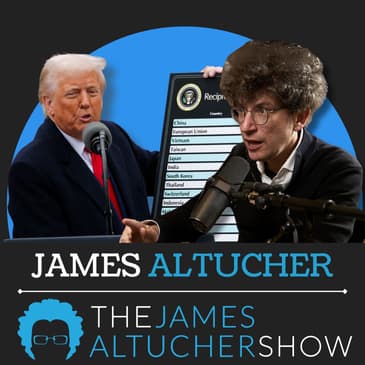



A Note from James:
I can't think of anything more boring to talk about than tariffs, but right now, I can't think of anything more interesting either. Tariffs are dominating the news, stock markets are crashing, and everyone is scared. Are tariffs good or bad? Is Trump wrecking the economy or saving it? I'm going to address these questions, looking at what tariffs aim to achieve, their impact on the economy, the stock market, inflation, and even Bitcoin. Let's set aside politics and try to understand what's truly happening.
Episode Description
In this episode, James Altucher takes a clear, unbiased look at the recent tariff measures, exploring their economic implications without the usual political spin. He explains the genuine reasons behind the tariffs, evaluates whether they’re achieving their stated goals, and breaks down how these measures compare to historical tariff actions. James also explores the surprising reactions from global markets and discusses why the current public fear might be overblown.
What You’ll Learn:
- The real objectives behind the latest tariffs and whether they're likely to succeed.
- Historical insights on tariffs under previous presidents and their economic outcomes.
- How tariffs actually affect inflation, the economy, and your investments.
- The surprising truth about market fears and economic uncertainty indices.
- Practical insights on navigating your investments during times of economic turmoil.
Timestamped Chapters:
- [00:00] Tariffs: The Most Boring Yet Interesting Topic Today
- [02:00] Uncertainty Index at Historical Highs
- [06:00] What Exactly Is a Tariff?
- [10:00] Trump's Goals with Tariffs Explained
- [15:00] Immediate Reactions from Global Partners
- [23:00] Interest Rates, Inflation, and Economic Implications
- [28:00] The Real Reason the Stock Market Is Falling
- [34:00] AI, Crypto, and Opportunities Despite the Market Drop
- [37:00] How to Invest During a Potential Recession
Additional Resources:
- Federal Reserve Uncertainty Index
- Smoot-Hawley Tariff Act of 1930
- "The Intelligent Investor" by Benjamin Graham
- Nucor Steel Company
See Privacy Policy at https://art19.com/privacy and California Privacy Notice at https://art19.com/privacy#do-not-sell-my-info.
[00:00:01] This isn't your average business podcast and he's not your average host. This is the James Altucher Show. I can't think of anything more boring to talk about than tariffs, but at the same time, right now, I can't think of anything more interesting to talk about than tariffs.
[00:00:28] Tariffs are the only thing in the news that the only thing anybody's talking about. Stock markets are crashing. Everyone's scared. Everyone is arguing. I'm going to address all these things, but what is going on? Is Trump doing the right thing? Is he wrecking the economy? Is he destroying the economy? Is he punishing poorer countries unfairly? Well, look, there are a lot of different opinions and I want to say this is not a political discussion for reasons I will describe.
[00:00:57] Both parties have been massively in favor of tariffs over the past several decades. So let's just set aside your politics and just kind of try to listen with an open mind. I'm going to go over everything from what the goals of these tariffs are. Are those goals being met? What is the chance that this is going to ruin the economy? Why is this affecting the stock market so much? And how does this compare to other stock market crashes?
[00:01:25] What's going on with interest rates, inflation, Bitcoin? What will happen if there's a recession? What stocks should people buy? I'm going to address all these things. Again, I think tariffs now are affecting the stock market for many reasons, but it's important to know 62% of all U.S. adults own stocks. So that's about 162 million people own stocks. It's the highest level since 2007.
[00:01:55] Before the Great Recession, which started in 2008, about 65% of U.S. adults own stocks. So we're almost at that level. And that's what made the Great Recession so painful for the stock market is because it was the highest number of adults ever that owned stocks. And we're at a similar level now. Now, normally that's a good thing. People are positive about the stock market and they're putting their savings in growing companies. I'll address this again in a little bit.
[00:02:24] But first, one thing to note that's really interesting is I think it's just as of yesterday, and I'm talking on Tuesday, just as of yesterday, the Federal Reserve keeps track of something, what they call the uncertainty index. And that's a combination of a bunch of factors, but it measures basically people's fear about the economy and the stock market. They've been measuring this since 1985.
[00:02:49] And as of yesterday, the Federal Reserve Uncertainty Index is at its highest level since they started measuring it. That means people are more scared right now than they were in March 2020, in October 2008, 9-11. And if you remember this, the great crash of 1987. But that boggles my mind because I would bet you a fair amount of people don't even know what a tariff is.
[00:03:17] And yet they're more scared than, again, in March 2020, when the New York Times said 100 million people in the U.S. might die from this global pandemic. And they were shutting the entire economy down. So people are more scared than then. They are more scared than October 2008, when it looked like every bank on the planet was going out of business. It looked like capitalism was dead.
[00:03:43] And people are more scared right now than 9-11, when the U.S. was invaded. So just take a step back for a second. Before you say, are tariffs good or tariffs bad? Just take a step back and just ask yourself, is this really as scary as March 2020? When, again, everybody was scared because not only was there a pandemic, with that first variant of COVID, a lot of people were dying. It was incredibly contagious.
[00:04:13] So it seemed like everybody on the planet was going to get it within a few weeks. And if you weren't even afraid of that, then the global economy was going to shut down. All of our products were coming from China. So China was clearly shutting down. That's where the COVID started. So would we get any medicines? Would we get products to make things? Would we even need products? I remember for a brief period in March of 2020, oil prices went negative. That's how crazy the markets were and how negative people were. And that was scary. Like, I was scared.
[00:04:43] And October 2008, I was going on CNBC all the time. And every day, another bank was shutting down. First, there was Lehman Brothers. Then there was Merrill Lynch. But then it started to look like Citigroup. The stock went below a dollar. It looked like it was going bankrupt. Goldman Sachs, everyone thought it was going bankrupt. I remember one time I went on the Fox Business Show Happy Hour. And that was shot out of a bar at the Waldorf Astoria at, I think, five o'clock every day.
[00:05:11] And I remember afterwards, I was just hanging out at the bar and I was listening to people talk. And it was all these bankers at the bar. And everybody was saying, oh, Goldman Sachs is about to declare bankruptcy. And I was scared. I was really scared. 9-11, most of you know my story, but I was at the World Trade Center on 9-11. I saw the first plane coming towards the World Trade Center as I was leaving the building.
[00:05:36] And look, I think it was beyond scary what happened. We didn't know if there was going to be another 9-11 size attack in the months afterwards. We knew the U.S. was going into wars. All these things were super intense and the stock markets all crashed. And yet now, the Federal Reserve Uncertainty Index is even higher than during those three times, which really astonishes me.
[00:06:04] And so, because if you take a step back, again, a lot of people don't know what a tariff is. I mean, is it a tax? Which country pays it? If you ask 10 people, you're going to get a whole bunch of different answers. And in addition to that, you know, some people say there's going to be good outcomes from these tariffs. Some people say there's going to be bad outcomes. So 77% of Republicans polled think that this is a good thing for the economy.
[00:06:32] And obviously on the Democrats, 93% of Democrats say this is going to be a bad thing for the economy, but there's no surprise there. But it's worth knowing. Some people think this is going to be good. And that ranges from, you know, people who don't know anything to billionaires and economists and same for the quote unquote other side. I'll get to the political aspect in a second. Again, try to stay above the level of politics that just don't have a reflex response for reasons I'm going to describe in a second.
[00:07:00] I'm bringing all this up because I will say this is not as scary as 2020, 2008, and 2001. And tariffs are not new in the U.S. Now, the last podcast I did about tariffs, I talked about 1929. I talked about the 1800s. I'm not going to talk about those again. But people are implying he's the first president to put on tariffs since the Smoot-Hawley tariff of 1929.
[00:07:25] Let's not forget Reagan, who was probably the biggest free trade president in the past 100 years. Reagan put tariffs on Japanese motorcycles. He wanted to protect the Harley Davidson from going out of business. Bush W. put tariffs on steel, particularly on Chinese imported steel to protest that they were dumping steel on the U.S. markets to lower prices and hurt the U.S. steel industries.
[00:07:52] Obama, he put 25% tariffs on Goodyear tires. By the way, a young senator named Chuck Schumer supported these. And Schumer specifically has repeatedly been in favor of tariffs against China because he doesn't like, and I agree with him, he doesn't like how China always steals our intellectual property, manipulates their currency to have lower prices, which hurts our industries, and on and on. Trump, of course, in 2018 put a 25% tariff on steel, 10% tariff on aluminum.
[00:08:21] It affected China, EU, Mexico, a bunch of other countries. Then he put an additional 25% tariff on $50 billion worth of Chinese tech products and another 10%. Then China retaliated, just like they're doing now. And then he put on another 10% on $200 billion worth of tariffs. By the way, in 2018, when he did this, I didn't even know. I mean, I was trading in the markets.
[00:08:45] I was writing about stocks and thinking about stocks and didn't even hit my radar. So Biden, okay, he kept the Trump tariffs and then he put another 100%, 100% tariff on electric vehicles coming out of China, 50% on solar products, 25% on steel and electric vehicle batteries. And Schumer, our old friend Chuck Schumer, he very much supported Trump's tariffs on China in 2018.
[00:09:13] Specifically, he said today, he, for referring to Trump, is doing the right thing. And Schumer also said something needed to be done to respond to China stealing U.S. intellectual property. In 2024, when President Biden expanded Trump's tariffs, Schumer said, Fighting China's unfair trade practices is something I have cared about for a very long time. It was one of the very first issues I focused on when I first visited upstate New York as a senator and saw for myself jobs leaving our shores.
[00:09:41] The Chinese party has shown that they will stop at nothing to steal our intellectual property and undermine our economy. So this doesn't have to be a political issue. Both sides, in some cases, support tariffs. And I think everybody has this question. The real thing that's different now is Trump didn't just put a 25% tariff on steel, aluminum, and other specific Chinese products.
[00:10:09] He put a 10% blanket tariff on all imports in the world. And he also put on reciprocal tariffs, what he's calling reciprocal tariffs, country by country. Now, people have brought up that the way they calculated this reciprocity was, it's not just that China had an average 67% tariff against us. So now we put a 34% tariff on China and so on throughout every country.
[00:10:32] This is more about, he calculated the 34% or the 67% more on how the trade deficit, the trade imbalances between China and the U.S. Meaning the U.S. buys a lot more products from China than China buys from us. And Donald Trump is sort of implying that all of that is unfair and he wants that to be even. Now, I don't know if Trump really believes that.
[00:10:59] It's, you know, in some cases, if a country produces better products than we do, we should buy more from that country than that country buys from us. If some country makes computers and another country doesn't, we're going to buy more from the country that makes computers. Or if some country really legitimately has lower prices, we'll probably buy from that country rather than that country buying from us.
[00:11:25] But, you know, President Trump's making the point that he's making two points and I'll get to this more deeply. But he's basically saying that it's not just that China and other countries have tariffs against us, but they also manipulate their currencies. Like China always manipulates its currency. So its currency is less valuable than the dollar. So they will always have lower wages than the U.S. will.
[00:11:53] And his point is that hurts U.S. industries. And he makes the further point that regardless of tariffs, why is it the case there's no U.S. cars driving around in China? And why doesn't Europe drive America cars, but we're driving all these European cars? Again, you can argue Europe makes better cars, but I don't think that's the right argument. There's something else going on. So he's just, he put these extreme tariffs out there, the most extreme since Smoot-Hawley in 1929.
[00:12:22] And of course, Smoot-Hawley in 1929 resulted in the Great Depression. But there are a lot of differences. I got into them last podcast. I'm not going to discuss the Great Depression here. But let's just take a step back. The first thing I see people arguing about, other than the size of the tariff, is what are President Trump's goals with these tariffs?
[00:12:43] And from what we can gather from watching not only what President Trump has said, but Treasury Secretary Scott Bessent, Howard Lutnick, Peter Navarro, and even people who are commenting like Elon Musk and so on. There's three goals to these tariffs. And by the way, all of these goals are important. And these goals aren't exclusive, meaning you could have more than one goal on these tariffs.
[00:13:10] The goals are bring manufacturing back to the United States, get revenues from high tariffs so that the U.S. could possibly lower income taxes if we bring in a lot of revenues, hundreds of billions of dollars or trillions of dollars in revenues from these tariffs. And there's a third goal, which is a little more nebulous, which is country by country. Can we negotiate other strategic objectives?
[00:13:37] So, for instance, we've already been negotiating with Mexico and Canada about it will reduce tariffs or will bring tariffs to zero if you stop fentanyl going over your border and you stop illegal immigrants going over your border. So these are issues that have nothing to do with tariffs, but Donald Trump is using the tariffs as leverage to get people to the negotiating table. So, again, three goals, manufacturing, revenues for the country, negotiating. Is he going to really bring manufacturing back?
[00:14:05] Well, there's some evidence from 2018, from 1988, from other times that leaders have put tariffs on that some manufacturing will come back to the U.S. It's not necessarily huge. Like in 2018 or 2019, the U.S. added about 30,000 autoworkers because of the tariffs on Chinese cars. So, OK, it's neither here nor there, but it makes a dent. And again, these tariffs are higher, so it might make more of a dent. Revenues. Will we get revenues from other countries?
[00:14:35] That, I think the answer is clearly yes. The fear is that those revenues might not balance off the loss in the economy that results from industries not being able to do free trade. But we'll probably make somewhere between, let's say, worst case, $200 billion in revenues annually because of these tariffs. Best case, $500 to $700 billion annually from these tariffs. And I won't get into the math of how I calculated that, but that's the best and worst case.
[00:15:03] Keep in mind that the government deficit, what we spend versus what we bring in in revenues last year was about $2 trillion. The government spent about $7 trillion and the revenues of the government, mostly from income taxes, were about $5 trillion. So bringing in $700 billion, it does make a dent, yes, but it's not the biggest thing in the world. Take a quick break.
[00:15:33] If you like this episode, I'd really, really appreciate it. It means so much to me. Please share it with your friends and subscribe to the podcast. Email me at altitra at gmail.com and tell me why you subscribed. Thanks. And then we have to look, what do we want to negotiate?
[00:15:57] So again, there's some strategic objectives, but let's just say the very first thing we want to negotiate is we simply want everybody to stop putting tariffs on us. So countries that had tariffs on us, we didn't always have tariffs on until now. And President Trump is saying, look, if you have tariffs on us, we want to negotiate that you don't have tariffs on us. And then guess what? We'll bring our tariffs to zero too.
[00:16:23] And so Scott Bessent over the weekend said already, just a few days after all these tariffs were announced, he said 70 countries have already called his office and want to negotiate. He didn't give the names of all the countries, but I'll list a couple of them. Vietnam called. Vietnam wants zero tariffs. Not only that, Vietnam wants to give us a deal on manufacturing.
[00:16:44] We don't always have to bring all the manufacturing back to the U.S., but we want to diversify from China so we're not so dependent on one country for all our medicines, all our electronics, all our rare earths. That makes sense, right? Anybody listening to this will think that that makes sense. Japan has called. They've signaled that they want to do these tariff negotiations very quickly and continue its close friendship with the U.S. India is already in talks. They're going to do tariff reductions.
[00:17:14] They have a $46 billion trade surplus with the U.S. They're going to figure it all out. South Korea has called. European Union. The European Union president has said that she would like zero for zero tariffs on industrial goods. So, let's see. We'll see what happens when they negotiate. Canada, of course, is negotiating. Mexico is negotiating. They've already negotiated down to zero. Taiwan, facing a 32% tariff.
[00:17:41] Taiwan has pushed for strong negotiations. And they're saying, look, Taiwan Semiconductor is investing $100 billion, maybe up to $200 billion in the U.S. to build facilities to manufacture chips in the U.S. rather than Taiwan. This is an important strategic objective for the U.S. I don't think anyone would disagree. We always talk about how we've talked on this podcast with generals about how it's a big risk that China might invade Taiwan.
[00:18:09] Well, this is where 95% of our semiconductors come from. So, it's an important strategic objective for the U.S. to have semiconductors made here. Now, we don't want to pay for that, though. It's so using these tariffs as negotiation, Taiwan and Taiwan Semiconductor is going to pay for $100 billion for facilities to be built here. So, that's a good sign.
[00:18:32] And Italy, of course, as a friend of Trump's and Elon Musk's, the prime minister of Italy, Georgia Maloney has said she wants to negotiate. UK wants to negotiate. Thailand, Argentina, Indonesia. So, 70 countries have indicated they want to negotiate. So, I would say negotiations are going to happen and a lot of the strategic objectives are going to be met. Now, one country which has not really called to negotiate is China.
[00:18:59] And that's the one we really are kind of most the enemies with in this trade war, if you want to call it enemies. In fact, they've established, you know, a retaliatory tariff. But, you know what? We don't care about the retaliatory tariff. We are the customer. This is why, you know, one person said to me, well, why couldn't we just negotiate? Why do we have to put on the tariffs? Tariffs have only been on a few days and already 70 countries have called. So, clearly they're working as a negotiating tactic.
[00:19:29] But it's important to note why they are working. It's because the U.S. spends more than any other country buying goods. We are the customer of the world. We spend over $3 trillion, about $3.13 trillion buying goods from all over the world. Nobody comes close. I mean, China spends about $2.5 trillion. I think Germany is about $1.5 trillion. And then it goes straight down from there.
[00:19:54] So, by far, no other country can afford to lose the U.S. as a customer. It doesn't even, there's not even a question. That's why in just days, first off, Scott Bessent said the countries that call earlier are going to benefit a lot more than the countries that call later. So, 70 of the largest countries in the world, other than China, have called and said they want to negotiate. That's a good sign.
[00:20:21] And, again, I don't think the onshoring of manufacturing is going to be all of that relevant. I do think the revenues are going to be good, but not enough to, for instance, eliminate personal income taxes. But we'll see. But the most important thing is the negotiation. And it looks like the rest of the world is going to negotiate. And this brings up an interesting point. Everybody says, oh, Trump doesn't care about all the other countries. He's just, it's America first. Which is true.
[00:20:50] But that doesn't mean Trump is against free trade. In fact, these tariffs show Donald Trump wants an enormous amount of trade with other countries. He put a 10% blanket tariff on all imports. He's referred to how in the 1800s, the tariff revenues were so huge, the U.S. did not have an income tax because tariffs paid for everything that went on in the United States. So, he wants to have fair trade where if you have a tariff against us, we have a tariff against you.
[00:21:18] If you have no tariffs against us, we'll have no tariffs against you because then free trade generates a lot, you know, grows the economy much better. There's four types of trade you could have. There's free trade where there's no tariffs. There's fair trade where if you tariff us, we'll tariff you. There's protectionism, kind of like how when Reagan put a tariff on motorcycles, Japanese motorcycles, or when Obama put a tariff on Chinese steel, that's protectionist, meaning
[00:21:47] you want to protect certain industries in the U.S. If Japan was undercharging for their Yamaha motorcycles, we don't want Harley Davidson to go out of business. So, Reagan was protecting Harley Davidson. Obama was protecting U.S. steel manufacturers. Does that work? Sometimes it works, sometimes it doesn't. And then there's a fourth type, which is isolationism. And so, I'll give you an example of a guy who was an isolationist. Hitler was an isolationist.
[00:22:15] He didn't want any trade with any other country at all for two reasons. One is, if Germany depended on, I don't know, France or the U.K. for bullets or for food, then what's going to happen when Germany invades the U.K. or invades France? They were too dependent on the U.K. or France, so their food supplies are cut off. So, Hitler really wanted all manufacturing and all production to happen in Germany.
[00:22:44] There was another reason, too, is if Germany made the best cars, he didn't want those cars being sent to other countries that they were about to invade. So, Hitler was the worst guy ever on the planet, and he was a complete isolationist. A current example of isolationism is North Korea. They don't really import or export anything. Maybe they do a little with China, but that's about it. So, these, like, really bad, evil countries are isolationists. Donald Trump is definitely not an isolationist.
[00:23:14] He wants to make huge revenues from trading with other countries. And he also enjoys the leverage that the U.S. has of being the largest customer of the world. He just wants people to spend more of their dollars here, but not all of their dollars here. So, in terms of his objectives, it looks like, at first glance, he's getting them. We don't know what the effect of the Chinese retaliations are, but it looks like he's meeting his objectives, particularly the negotiating objective. And we'll see what happens.
[00:23:43] Will it become a zero-tariff world? He doesn't care because he just wants fair trade, and he wants other strategic objectives. So, again, I question why the uncertainty index should be so high and why the stock market is falling so much. There's other economic things that are going on. The 10-year note has fallen, and I'll explain what all this means and why it's important. The 10-year note, which is the amount of interest the United States government pays on their 10-year treasury bills,
[00:24:13] this interest rate has fallen from 4.8% to below 4%. Right now, it's about 4.2%. This is incredibly important. For one thing, this is more related to mortgages. So, if those rates are going down, then your mortgage rates are probably going down, meaning it's more affordable to buy a house. But more importantly, the U.S. has to borrow $10 trillion this year. Now, why does it have to borrow so much? Well, it owes $9.5 trillion by the end of this year.
[00:24:43] And when the U.S. has to return the money it borrowed, it doesn't just write a check. What it does is it borrows the same amount and uses the new money that it just borrowed to pay off the old money. And what that does is that whatever the interest rates are, if the U.S. borrows money, it's got to pay those interest rates. So, the U.S. wants long-term interest rates, like the 10-year note, to be lower.
[00:25:07] If it has to borrow $10 trillion and that interest rate is 1% lower, that's $100 billion a year in savings. So, that's very significant. Some people have suggested that that's one of the goals of Trump with these tariffs. I personally don't know if that's true. I will tell you my experience from, like people are saying, oh, you know, the Trump administration's playing 4D chess.
[00:25:32] I'll just tell you my experience from chess is that the more moves ahead you have to calculate, the more likely you are that you're wrong. It seems to me they're calculating too many moves ahead if they really plan on bringing down long-term interest rates. But you never know. The other thing is interest rates go down when people feel that the economy is going down because they don't think there's going to be inflation. They think there's going to be deflation. That's why interest rates are going down.
[00:26:00] Now, if interest rates go down too much, then inflation starts again. And, you know, so there's a balance. And that's what the Federal Reserve has to keep an eye on. Again, I will repeat this from my earlier podcast, but I'll be a little bit simpler about it. But tariffs do not cause inflation. Yes, tariffs will make some products go up in price.
[00:26:23] If the United States gets all of its steel from China, which it doesn't, then the price of steel will most likely go up if we put a tariff or a tax on steel coming in from China. Because China will raise prices to handle paying the tariff. What is inflation? Inflation means the value of your country's currency is going down. So all products are more expensive.
[00:26:49] And if wages don't go up correspondingly, then people feel broke. So inflation by itself is not so bad. It's bad when inflation of products is outpacing inflation of salaries. Tariffs never cause countrywide inflation. And I'll just give as an example again, during both Trump and Biden administration, an enormous amount of money was printed to bail out the people in the pandemic because of the lockdowns.
[00:27:17] And inflation the next year went up to 9%, from 2% to 9%. But when Trump did those tariffs in 2018, inflation did not go up. They did not go up higher than 2%. It was around 1.7% to 1.9%, which is lower than where the Federal Reserve likes it to be. Don't forget, deflation is bad. When deflation happens, the economy shuts down. People say, oh, this house is lower than it was last month.
[00:27:45] I'm going to wait another month before I buy it because it'll probably be even lower. And that creates this death spiral. Everybody just sits around waiting for prices to go as low as possible. Because they're not buying, that makes prices go lower. So it's a spiral down. So deflation is the worst possible thing that could happen to a country. When has the U.S. experienced deflation? It experienced it in March 2020 when everybody stayed home. It experienced it very slightly in 2008, 2009 because everybody's banks were going out of business.
[00:28:15] It experienced it very briefly in 9-11 because everybody was scared. But note, those were all bad times. And so deflation is also probably happening right now, or at least inflation is reducing. So there's a site called Truflation where they show that just in the past few months, and they track it as much as they possibly can. Inflation has gone from 3.2% to about 1.2%. So tariffs are not inflationary.
[00:28:43] Can we just stop talking about that? Yes, it's true that tariffs raise prices on certain products, but they are not inflationary. Now, what is happening with the stock market?
[00:29:09] Well, what's happening with the stock market, it can't be about the tariffs by themselves because, again, nobody really knows what they are or what the results will be. Although the dust is settling, it's starting to look like the results are going to be okay. They don't have to be great, but we're talking fear levels at the level of the March 20 pandemic. The pandemic, it's one millionth of that. So who knows what will happen with the tariffs?
[00:29:36] But he's going to negotiate with a bunch of countries, and it's going to be fine. And eventually, China and the U.S. will sit down and figure it out. Trump has said he's open to negotiating with China. China's economy is already crashing. They don't want to completely crash it. So eventually, they'll come to the table. We don't even know what's being talked about behind the scenes.
[00:29:56] But what's really affecting things is I think the political distance between the far right and the far left has infected the media so much that this is creating just this gigantic catastrophe in the market. The market is like the baby, the child of all the anger that's being directed at both sides.
[00:30:21] The stock market can be thought of as like a barometer on the psychology of the planet or the country. And right now, the U.S. needs to take its meds and just stabilize a little bit. Like everybody should stop. Again, I've described tariffs as being an apolitical issue in general. Everyone needs to just hold on and stop arguing of each other. And obviously, that's not going to happen. So eventually, what's going to happen is people are going to see, oh, well, they didn't stop building new AI companies.
[00:30:51] And AI is going to add $15 trillion to the economy over the next few years. I guess that's still good. So AI stocks are good. And all the industries that AI powers is still good. So for instance, it's great that NVIDIA is profitable. But what really is interesting is how profitable John Deere is going to be. John Deere makes tractors and other farm equipment. Guess what?
[00:31:14] The tractors are going to be self-driving, full self-driving, which means farmers are going to be able to spend their time developing other opportunities and revenue sources for themselves. Tractors also are going to use AI to identify where the weeds are so they could save as an industry tens of trillions of dollars on pesticides. So this is just an example of one company in one industry that is going to use AI to create millions of dollars more in profits, maybe much more than that. I talk to a lot of companies. I'm invested in a lot of companies.
[00:31:45] So I hear from the companies I'm invested in. Every division of every company in every industry is being told, you must figure out how to use AI to increase our profits. So there's going to be robotics that are going to add to America's manufacturing capabilities. That's going to be all over the U.S. There's going to be, you know, everybody. I'll just give you a simple example. There's a company. We had the CEO and the chairman on the podcast. It's a company called HealWell.
[00:32:14] HealWell, it has 18 million patient records that it fed through its AI. So now when a new patient comes into the clinic and HealWell's largest shareholder owns a chain of medical clinics and other clinics are using HealWell's services. By the way, I'm not trying to promote the stock here. It just is what it is. I am a shareholder, though. I say this because it doesn't need me to promote it. It's going to do fine on its own.
[00:32:36] But they fed these 18 million patient records into an AI, and when a new patient comes in, he or she says, oh, my knee hurts, my ear hurts, and I have a headache. It goes through the AI, and based on the patient records and what the AI has learned from 18 million other patients, it's able to figure out, given the patient's history and what he's saying, what the best possible diagnosis is, what further tests this patient should have. And it turns out to be, I don't know the stats, but like 100% more accurate than just seeing a doctor.
[00:33:06] Not that doctors are bad and not that doctors aren't necessary, but AI is going to speed up disease prevention, disease cure. It's going to add to our longevity. So I've just talked about agriculture. I've talked about basic medical, but AI is being used to come up with new drugs to cure diseases. AI is, you know, doing everybody's, like, I'll give you another example. And this is a private company that I'm invested in that does this.
[00:33:33] I won't mention the name of the company, but every big corporation has offices in hundreds of locations and countries and states. And every country, every state, every city has different tax rules. And it's hard to kind of what's called consolidate all your tax returns. So you really know where your company stands in terms of taxes. It's really hard. Every year, it takes the whole year, hundreds of people per some of these big companies to figure out their taxes.
[00:34:02] But with AI, you could do it literally in minutes without the use of these people. These people could be put to more profit making jobs within these companies. So, again, these are just a few examples. There's much bigger examples, of course, when you start talking about the full capabilities of robotics and cars and all the learning models and so on. But AI is not going anywhere. Crypto is not going anywhere.
[00:34:28] It's interesting to note that before all this tariff stuff started, Bitcoin was around $80,000. And now, as I'm talking, Bitcoin is around $80,000, even though the markets have tanked. So this is the first time since the invention of Bitcoin, since the creation of Bitcoin, that Bitcoin has not tanked completely with the stock market. Now, it's gone down a little bit with the stock market, but not completely.
[00:34:55] This decoupling of crypto and the stock market is an event that people have been waiting a long time for. And it seems to be happening. So why is this happening? Well, people know that you still need currencies in the world, obviously. And people know there's other uses of crypto. Crypto is not just a currency anymore. And I won't get all into it, but there's 100 different use cases of crypto. And I could get into it some other time if people want.
[00:35:22] All these things have nothing to do with the stock market. But should you invest in the dollar? Should you invest in the Japanese yen or the EU euro? Who knows? But Bitcoin, which the supply will never exceed 21 million coins. We know that that's a, I don't want to say a completely safe haven. It's still a risky asset. But if you're uncertain about the dollar and if you're uncertain about the euro, probably your next best choice is to invest in Bitcoin.
[00:35:52] By the way, let's compare it with gold. Gold is not a currency. Gold is only a store of value, meaning you can't use gold to buy anything in this country. Maybe I don't even know if any other country uses gold at all. And the thing is, gold, yes, has a limited supply, but we don't really know how limited. There's still millions of tons of gold under the ground. We just don't know how much. We know how much Bitcoin there is. And by the way, gold has no use case. You could say Bitcoin has no use case as well, but that's not true.
[00:36:22] So there's millions of man hours of programming that was done to create Bitcoin and Ethereum and Solana and all these other cryptos. They have enormous use cases. I would encourage you to study that. Maybe I'll do another podcast separately on that. I am pro crypto, but guess what? This administration is pro crypto also. So not only has Donald Trump said he wants the U.S. to be the crypto capital of the world, he appointed David Sachs, who's a huge crypto investor, to be his crypto czar.
[00:36:50] He said crypto will be in the strategic reserves. And then, by the way, his family started two companies, World Liberty Financial, which has bought maybe $100 million worth of not only Bitcoin, but other cryptos. And just the other day, Eric Trump announced he's starting a company, American Bitcoin, to be a Bitcoin miner. So guess what? Crypto is going up from here. All of crypto. Not every single coin. There's millions of coins, but all the important ones are going up.
[00:37:18] And I'd start, honestly, I would start with the ones that Donald Trump owns. Just Google WLFI or ask AI, what coins does Trump own? And I believe the answer is Bitcoin, Ethereum, Solana, Chainlink, Avalanche, and maybe AAVE, which helps create crypto exchanges that can lend against other cryptos, which is an important use case for banks and exchanges. And I said I would mention some stocks that handle tariffs well.
[00:37:48] Walmart, WMT, happens to be particularly good at changing supply chains really fast. That's why they've always been the winner. New Core Steel makes steel here in America. I think, but I think right now, just about every stock is down too much. Like if you look at like Exxon, it's even down 10 or 15% and has a 4 or 5% dividend. Or if you want a micro cap stock, I like a company, BitDigital, BTBT.
[00:38:15] $350 million value between their crypto and their cash. They have $200 million worth of liquid assets and they make in profits about $50 million a year. So this is cheap. But I'm just giving random examples. There's thousands of stocks that are cheap right now. And finally, I will say, will this cause a recession? Well, frankly, we may already be in a recession. You never know if you're in a recession until the recession is over.
[00:38:40] And I will tell you though, what happens after a recession? So in the recession of 2007 to 2009, one year later, the stock market was 14% up. Three years later, the stock market was almost 60% up. So in the recession of 1990 to 1991, one year later, it was 11% the stock market. June, 1981 to November, 1982, stock market was up 25%. And on and on.
[00:39:08] On average, since World War II, one year after a recession, the stock market is 20% up, which is three times higher than the usual annual return of 7% on the stock market. So if we're in a recession right now, then that means this is the time to buy stocks. Now, I'm not encouraging you to buy stocks. I'm not advising you to buy stocks. I'm just telling you what is statistically likely to happen. Or even if it's not statistical, like in the sense that there's a huge number of examples,
[00:39:37] it's this is what's happened. And I just would fight that feeling of fear and anger that I know everyone is experiencing. I'm seeing it on the threads I post on Twitter. I don't even mention the Republicans or Democrats once on these threads. I just try to explain tariffs, but people are right away putting on their Democrat hat or the Republican hat and they're screaming and yelling. And no matter what you say, they try to find something else.
[00:40:06] And until there's no more points to make, nobody's making any sense anymore. So try to listen to what I've said. In summary, I would say people are unduly scared. This is not as bad as 2020, 2008, 2001. Trump's goals are manufacturing in America, revenues for America and negotiating for America.
[00:40:31] I think he's getting a little of the first two and a lot of the last one, which will lead to fairer and freer trade. Already 70 countries have called to trade. We'll see what happens with China, but we've dealt with China many times in the past. We've had our ups and downs with China. It's going to be fine. And even if it's not fine and we're in a recession, stock market's usually up because the Federal Reserve starts printing money when the economy goes into recession. That's what they always do. That's what they will still do.
[00:41:01] By the way, Trump is appointing a new Federal Reserve chairman a year from now. This guy is certainly going to pump money into the economy for better or for worse, by the way, I'm not saying this is a good thing, but it's going to make the stock market go up and markets anticipate. So we'll see what happens. Are tariffs inflationary? No, I've proved this again and again. Does Trump want to be an isolationist? No, he wants free and fair trade. And that's about it.
[00:41:28] If you have any questions, follow me on Twitter at Jay Altucher and ask me the questions. If there's a need to do another podcast on this, I will answer them on the podcast. Otherwise, I will gladly answer them on Twitter. If you have questions about anything else or anything else you want me to talk about, ask me on Twitter. And please share this with your friends. If you think this will help people understand a little bit more about what's going on with tariffs, what are the goals? What will the results be? Why are we so afraid and why we shouldn't be so afraid?
[00:41:57] Thanks very much for listening to me. I hope this wasn't too long and wordy.